Translate

Showing posts with label astronomy. Show all posts

Thursday, February 27, 2020

Betelgeuse Betelgeuse Betelgeuse!

You may have heard that Betelgeuse, one of the brightest stars in the night sky, is fading. The orange star forms the top left corner of Orion, probably winter's most easily recognizable constellations. Prior to this dramatic dimming, Betelgeuse was in the top ten brightest stars. Now it doesn't even crack the top 25. It's been clear the last few nights, and it seems to me that Betelgeuse is a little brighter than it had been, but it may be a matter of lighting since I live in civilization.
While the star will certainly end its stellar life with a supernova explosion, astronomers are fairly certain that won't be happening any time soon. Betelgeuse is a variable star, meaning its brightness changes, but that change isn't usually this noticeable or long-lasting. Current trending possibilities for the dimming are an ejection of dust or a cool surface area.
Betelgeuse's location in Orion (Constellation Guide)
If a cloud of dust came between Betelgeuse and Earth, that would obscure light from the star and make it appear dimmer. It could be an interstellar cloud or material ejected from Betelgeuse itself. The cool area on Betelgeuse's surface wold have to be very large to cause a noticeable dimming here on Earth. That cool spot would be similar to the sunspots we get on our own star, only much larger.
If Betelgeuse were to go supernova, it would be the event of a lifetime. In brightness, it would nearly match a full moon for months. It would be visible during the day for about a year.
This week's information comes from AccuWeather.

Thursday, November 14, 2019

Transit of Mercury

Frequently, we observe solar and lunar eclipses here on our blue marble we call Earth. Solar eclipses are when the moon passes in front of the sun. Lunar eclipses are when Earth cuts between the sun and moon, with the moon covered in our shadow. Less commonly observed are planetary transits. Because we live on the third rock from the sun, we only get to see Mercury and Venus pass in front of it. Because orbits wobble and planes aren't aligned, this is something that is only seen a few times per century.
Transit of Mercury as seen with the unaided eye
Mercury transited the sun on November 11. Because the sun is so bright and Mercury is so small, a telescope with solar filter is a requirement to witness the event. I took a field trip to Philadelphia's Franklin Institute to see it for myself with their telescope. Because seeing Mercury normally requires a clear horizon at sunrise or sunset, most folks don't get to see it. This was my first time, and now I've finally seen all six naked eye planets- I included Earth, which I see every day.
Franklin Institute's telescope with solar filter
I got a shot of Mercury being live-streamed on the big screen
Sadly, I wasn't able to get my own pictures of Mercury, but I did get pictures. NASA was live-streaming and has a video up on their Youtube page. If you want to see a Mercury transit live and in person, you'll have to wait until 2032. You'll need to be in Africa, eastern Europe, or western Russia to see it. Otherwise, the next transit here in the states won't be until 2049. But if you think that's bad, the next transit of Venus won't happen until 2117.
NASA posted this picture of a prior transit on their Facebook page.
The little black spot on the bottom is Mercury. The one on
the top is a sunspot.

Thursday, March 28, 2019

A Star Is Born

Stars are the most common object in the night sky. They come in different colors and brightness. Grab a pair of binoculars and the number you can see goes from too many to count to more than you thought possible. It seems as though they've always been there, but where did they come from?
Orion Nebula, a stellar nursery (NASA)
Gas and dust in space pulled together by gravity attract more material. More mass has more gravity, so it continues to attract more material, while also collapsing into itself. As it collapses and becomes more dense, it begins to hear up. At some point, what is now considered a core begins to fuse hydrogen atoms into helium. The pressure of the energy radiating from the new star is enough to keep it from collapsing into itself further.
Not all of the gas and dust gets sucked into the star. It will swirl around the star and conceal into planets and asteroids, like what happened here in our solar system. In other systems, multiple stars may form rather than just one like we got stuck with.
Life cycle of a star (NASA)
If a star is massive enough, it will blow itself apart in a supernova. Gas and dust from the exploding star will fly out into space and the process will begin again. This week's information comes from NASA.

Thursday, February 1, 2018

Nature Minute Book Club

It's February and the days are getting noticeably longer, but we still have quite a few cold weeks ahead of us here in the Northeast. This month is like life in the Stone Ages: nasty, brutish, and short. I have snow coming twice before the Super Bowl is over, and I'm pretty sure more will be along shortly afterwards. Once the big game is over, what else is there to until spring but read? Having said that, feel free to peruse these titles from the Nature Minute book shelf.

Voyage of the Turtle: In Pursuit of Earth’s Last Dinosaur by Carl Safina
Safina travels the globe following sea turtles from their nesting grounds to their feeding grounds and points in between, looking for answers. What’s being done to protect them? What are the negative impacts people have on them, and how can we reduce or turtle-stomping footprint? Just where to they go and what do they do? If nothing else, you’ll learn just how immense these magnificent critters are and how they have adapted to a carefree life adrift and the challenges they face.

The Hidden Life of Trees by Peter Wohlleben 
Wohlleben, a German forester, takes us into the heart of his forest to show us how trees interact with friends and family, other tree species, and the animal world. Fascinating ideas about tree cognition, memory, and communication, as well as trees’ nurturing abilities will change the way you look at plants. Is a forest bigger than the sum of its parts? 

The Sun’s Heartbeat by Bob Berman
This book is the sun’s biography, from its humble birth to its spectacular future death. In between, learn about our changing relationship with the sun over the centuries, how it influences everything, and take a historical trip through own growing sea of knowledge about our nearest star. A seasoned skywatcher, Berman has yet to lose his sense of awe over solar eclipses.

Travels in Alaska by John Muir
America’s leading conservationist of the 19th century recalls his journeys to Alaska in 1879, 1880, and 1890 in this book, which was still unfinished as the time of his death. Relying on his careful expedition notes, Muir gives a poetic narrative of his voyages exploring mountains and glaciers and documenting the flora and fauna of the Last Frontier while describing the scenery with a sense of reverence and awe. His love of life and the outdoors really shines through.

The Thing With Feathers by Noah Strycker

This book is about birds and people. Not relationships between the two, but common traits that will shock you. In some regards, birds are just as intelligent as humans. Sometimes, understanding their behavior helps us understand human nature. Deep down inside, on some basic level, maybe we’re not above the animals. Language and culture are thought to be defining human traits, but what happens when a “lower” animal develops art?

Thursday, January 25, 2018

Lunar Lunacy

Next Wednesday (January 31) the world will be treated to a trio of rare lunar occurrences, all at the same time. A blue moon, super moon, and total lunar eclipse all fall on the same date. What are all of these? Let’s break it down one item at a time.
Humans love to name things, and a blue moon is simply when a second full moon happens in a single calendar month. Our first full moon was on New Year’s Day, which in itself is one of those rare events that people seem to think means something. Sometimes the moon actually does appear to be blue, but that is usually due to atmospheric issues like pollution.
A super moon is when the moon reaches its closest approach to Earth (the moon’s perigee). Our orbit around the sun isn’t round, it’s slightly elongated. The moon’s orbit of us is the same. When the moon is near or at perigee, it appears slightly larger than usual. It’s barely even noticeable to the human eye.
Diagram showing the moon's elliptical orbit (NASA image)

A lunar eclipse is when the moon passes through Earth’s shadow. This event only happens during a full moon, when the sun fully lights the side of the moon facing Earth. This puts Earth between the sun and moon. A solar eclipse requires a new moon, and places the moon between sun and Earth. During a lunar eclipse, the moon sometimes appears red. It’s also known as a blood moon. Next week we are treated to the rare super blue blood moon. That’s a mouthful!
Diagram showing the sun, earth, and moon positions during
an eclipse (Smithsonian Air and Space Museum)

NASA photo of a blood moon
The best lunar eclipse I’ve ever seen was in 2015. The eclipse began before moonrise, so by the time it came up over Mount Rainier it was already red. This time, I'll get to see it on my way to work, assuming we have clear skies.
Lunar eclipse over Mount Rainier

Partial phase of a lunar eclipse

Thursday, December 28, 2017

Star of Wonder

Science is very good at explaining things and can even solve a mystery that has no remaining witnesses. Science is able to tell us how long ago a frozen cave man lived, and even how he died. One mystery that science has been unable to explain, but has offered many possible solutions to, is the Star of Bethlehem that the Magi followed. The star is mentioned in the gospels, and many biblical events have been confirmed by archaeology. But is the star a legend, a myth, a miracle, or something perfectly logical?

There are several astronomical phenomena that could explain the star. People at the time were very astute when it came to sky watching, as the stars and moon were (and still are) great navigational aids, so anything out of the ordinary appearing in the sky would have been noticed and documented. Some examples of astronomical phenomena that could have occurred on the First Noel include a planetary conjunction, a nova, a supernova, and a comet.

A planetary conjunction is when two or more planets appear very close to each other in the night sky, and may even appear to be a single object. Just such an event- a Jupiter and Saturn conjunction- took place in the year 7 BC, just outside the accepted date of Jesus’s birth (6 BC- 4 BC). The timing is very close and the position in the sky is correct, but the planets were not close enough to appear as a single star and while the conjunction may have led the Magi in the general direction of Bethlehem from Jerusalem, but did not stand over Bethlehem as stated in the Bible. 
Conjunction of Venus and Jupiter, 2015
A nova (“new star”) is star that suddenly flares up many times in magnitude. It is given this term because in most cases, it is a star that ordinarily is not visible to the naked eye. Similar to a nova is a supernova, a star which has exploded. Chinese and Korean records indicate either a nova or supernova occurred in the year 5 BC, which also fits the timeframe for the nativity. Unlike the planets, however, a nova or supernova would remain in a fixed position in the sky. 
Remnants of 1987 supernova (NASA)
A comet is best described as a dirty snowball orbiting the sun. Depending on location and trajectory, they can become visible to the naked eye as they approach the sun. The period of visibility and brightness vary from comet to comet, but as an object in orbit, it would certainly move about the sky. Chinese records indicate a comet appearing in the year 5 BC, which is within the accepted time of Jesus’s birth. The comet’s location in the sky would have it preceding the Magi first to Jerusalem, then to Bethlehem. It even appeared during spring, which is when it is believed he was born, even though we celebrate Christmas in December. That’s a different story for a different blog. 
Comet ISON (NASA)
Over 2000 years later, the great mystery of the Star of Bethlehem may finally have an answer thanks to forensic astronomy and the meticulous records of the Chinese. Was it really a comet, a completely rational cosmic occurrence, which led the Magi to Bethlehem? If so, did divine intervention place the comet where it needed to be at the right time? That question might never be answered.

This week's information comes from two sources. Speculation about conjunctions and comets comes from Colin J. Humphreys and the speculation about novae and supernovae comes from Mark Kidger.

Thursday, October 19, 2017

Cloudy With A Chance Of Meteors

The Orionid meteor shower, happening through the end of October, reaches its peak October 20-22 (Friday-Sunday). Luckily, the peak nights for viewing are on a weekend; the best time for viewing the meteors, which appear to radiate from the constellation Orion, is around 2 AM. Expect to see about 20 meteors per hour.
The Orionids are named for the constellation they appear to radiate from. They are specks of dust and debris left by Halley’s Comet, which last made an appearance in 1986. Comets orbit the sun just like Earth, and leave behind a trail of junk as they orbit. They are basically giant, dirty snowballs and as they near the sun, they begin to melt somewhat, causing the debris trail. If a planet’s orbit crosses the debris field, whatever gets swept into the passing planet’s atmosphere will heat up and burn from friction. Odds are, those bright streaks you see in the night sky are no bigger than a grain of sand.

Meteor facts this week come from Space.com

Wednesday, August 30, 2017

Cosmic Ballet, Part 2

Despite dire warnings not to travel to Oregon for the solar eclipse, I went any way. Traffic was not as bad as predicted. My gamble that everyone going to Oregon would have left over the weekend paid off. My gamble that homeward-bound traffic would be going the opposite direction of where I was headed paid off. I even managed to get some pictures for those of you who weren't lucky enough to witness totality, which was a first for me.
Before totality, small chunk of sun missing from top right


The eclipse caused these funky curved shadows

Using your hands to make a pinhole viewer


Totality! The black circle is the moon, the white ring is the sun's corona
The sky was dark enough that some stars were visible. I think this is Venus.
The eclipse got underway just after 9 AM Pacific time, immediately preceded by a flock of birds flying overhead away from the sun. Was that related to the eclipse? I don't know. I don't recall seeing any birds until after the eclipse was over. It took a while to notice any changes in lighting, but as totality got closer it was like someone turning a dimmer switch until it got dark. At that point, the eclipse glasses came off, the pop of some fireworks, and the crowd at the nearby football field let out a cheer. It was oddly quiet and oddly dark for about a minute until there was a flash of light where the top of the sun came out from behind the moon and the dimmer switch turned the other way and daylight returned.
The next total solar eclipse to hit the US is in April 2024. At that time, I hope to be in the field studying how animals react to an eclipse. Not much is known because they are such an infrequent event. Many animals run on a solar (day-night) cycle and scientists like myself wonder what they do when night suddenly happens during the day for a brief period.
Stay tuned for more stories from the road following Nature Minute's great American road trip!


Thursday, August 17, 2017

The Cosmic Ballet Continues

This Monday the United States will witness the rare and majestic total solar eclipse. Not all areas will see a total eclipse, but all of North America will see at least some of the sun disappear. While not a rare event, it is unusual for a total solar eclipse to cover such a large populated area. It seems like usually they happen only over the remotest part of the Pacific Ocean or exclusively at the South Pole. This eclipse will the first total solar eclipse to hit the US since 1979. That might not be too terribly long ago, but think about this: in 1979 there were still people alive who could remember the last time the Chicago Cubs won the World Series (1908) or fought in the war against Spain in 1898.
What is a solar eclipse? When the moon passes between the sun and Earth and casts a shadow on us, that’s a solar eclipse. They can only happen during a new moon, which is when the sun’s rays hit fully on the “dark side” of the moon, so it’s the only time you’ll ever see a new moon. New moons happen every 29 days, just like a full moon, but we don’t have a solar eclipse every month because of how the sun, moon, and Earth dance with each other.
Geometry of a solar eclipse- not to scale (from Nustem)

You’ll notice the sun is a lot higher in the sky now than it was in January. Because Earth is tipped about 23̊ as were orbit the sun while spinning in our tipped circle (which also wobbles) the sun appears to ride a squashed and stretched figure 8 across the sky called the elliptical. The moon does the same, but their ellipticals don’t always match. When they do, you get an eclipse.
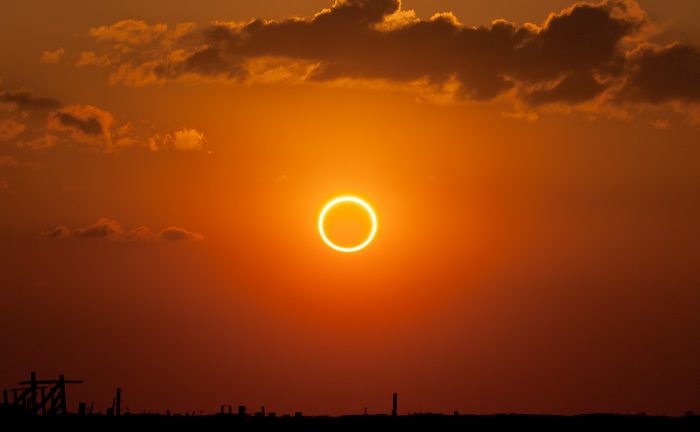
Distance is also important. Neither Earth’s orbit nor the moon’s is circular; both are slightly elongated (an ellipse, hence the term elliptical) so sometimes the moon close enough to block out the sun during an eclipse and sometimes it fits inside the sun like a ring. This is called an annular eclipse. Like during a total eclipse, only a narrow band will see the annular eclipse, while everyone else gets to see a partial eclipse or nothing at all.
Annular eclipse (from Universe Today)

Partial eclipse (from Huffington Post)

Always practice safe eclipse viewing! Follow these tips from NASA. Never look directly at the sun, even during an eclipse. The only exception is during totality, and that is ONLY if you have totality where you are at, and it only lasts about a minute and a half. Use eclipse glasses- if you put them on and try to see anything but the sun, you should only see blackness. Sunglasses will not do the job. Never look at the sun through binoculars or a telescope, unless you have a solar filter. If your solar filter screws on to the eyepiece, it is junk- throw it away! If you don’t have any safe viewing equipment, make a pinhole viewer by poking a hole through a piece of cardboard and let the sun shine through. During the partial phase, you will see a spot of sunlight missing a chunk in the middle of the cardboard’s shadow.

I will be in Salem, Oregon for the eclipse, immediately preceding a very special Nature Minute road trip. Sorry, no live-blogging. I can’t blog while driving, and besides, there’s no wifi in the wilderness. Check back in September or follow along on Facebook for pictures and tales from the road.
This week's credits: Nustem, Huffington Post, Universe Today, and NASA  

Tuesday, June 20, 2017

Summertime and the Living's Easy

Summer is officially here, at least astronomically. Today marks the summer solstice in the Northern Hemisphere, while our friends south of the Equator are settling in for a long, dark winter. What exactly is the solstice?
Summer solstice is the point at which the pole of the hemisphere in question most directly faces the sun. It’s the longest period of sunlight in a single day and the sun reaches its highest point in the sky. At the pole, it is 24 hours of daylight. The length of daylight decreases with distance from the pole, culminating in 24 hours of darkness at the opposite pole. 

Solstice occurs at 4:24 AM Universal Time (time in Greenwich, England on the Prime Meridian) on June 21st. Sunset at my location is 9:07 while solstice is at 9:24, which is on the 20th here. I won’t even see the sun when I am facing it most directly.

Interestingly, we associate summer with long days, but by the time summer actually arrives the days start getting shorter. And even though solstice is when we receive the most sunlight, it takes about a month before peak temperatures arrive. This is because the oceans affect heat absorption and distribution. For the same reason, peak coldness is usually a month of more after winter solstice. Of course, there may be exceptions but that is generally the norm at my latitude.
On an unrelated topic, this week is National Pollinator Week. Bats, insects (notably the bee), and the wind are pollinators you encounter on a daily basis. Go outside and hug a pollinator! Just not a bee.


Solstice diagram: http://www.almanac.com/content/first-day-summer-summer-solstice

Thursday, January 26, 2017

The Worlds Around Us

This week’s Nature Minute is out of this world! Nature isn’t just limited to Earth. Head outside after sunset and check out our neighbors in the solar system. Venus is the brightest object in the night sky and you can find it in the constellation Aquarius, in the southwestern sky. If you happen to have a telescope handy, look for distant Neptune just above and to the left of Venus. Higher above Venus and more the left but still close by is Mars, which appears to be a bright red non-twinkling star. Jupiter is the brightest object (other than the moon) after midnight. Again, if your telescope is handy and you are still awake, check out Jupiter. You may be able to see some of its moons. Jupiter, the largest planet, is almost like a mini solar system within our solar system. If you are an early riser, or maybe just can’t sleep, Saturn and Mercury rise just before the sun. Mercury is hard to see because it is close to the sun and therefore always low on the horizon. In my area, trees to the west or Cascade Mountains to the east make viewing Mercury impossible. Saturn is a treat to view through the telescope. Its rings are not visible to the naked eye, but they pop when viewed through the telescope. I’ve seen them a few times before and I never get over it. It’s very surreal. It looks fake.


Lunar eclipse

Venus (bottom) and Jupiter (top) in conjunction
To check out the planets and stars, get out of town. The darker the sky, the better. Up in the mountains, in the desert, or along the beach are great places for stargazing. The full moon is your worst enemy, unless you are checking out the moon. If you want to check out Saturn or Mercury, use caution not to get your telescope caught in the rising sun, unless you happen to have a solar filter. In that case, you really don’t need to be reading this blog. You probably know more about space than I do. This week’s planetary positions are courtesy of the good folks at EarthSky.org.