Translate

Showing posts with label range. Show all posts

Friday, August 7, 2020

Species of the Month

Introduction: World Elephant Day is next week, so to celebrate we’re profiling one of the world’s three
elephant species. In addition to the Asian elephant, did you know there are two different African
elephants? There’s the forest elephant and the more commonly known bush elephant, the August
Species of the Month.
African bush elephant (Wikipedia)
 
Scientific name: Loxodonta africana
Kingdom: Animalia (animals)
Class: Mammalia (mammals)
Order: Proboscidea (elephants)
Range: Central and southern Africa
Habitat: Savannah, forest, deserts
Lifespan: 60-70 years
Diet: Grasses, herbs, fruit, tree leaves, and tree twigs, roots, and bark
Predators: Lions, African wild dogs, hyenas, crocodiles, humans
Mother and calf (Wikimedia Commons)
Conservation Status: Elephants are listed as vulnerable on the IUCN red list. They are threatened under
the US Endangered Species Act.
Other Information: The African bush elephant is the largest land mammal in the world. An adult male
can weigh over six tons with a shoulder height of ten feet. Adult males live alone or in small groups,
while females and calves will form a larger herd led by a matriarch. Calves are raised communally
and are totally dependent on maternal care for several months. They reach full independence around
eight years old. Elephants don’t grow their tusks until after they’re a year old and the baby teeth fall
out. They also have a conveyor belt of six molars that wear out and fall out, allowing the next in line
to move forward. After losing the last molars, they can no longer eat properly. The large ears are great
for hearing, but also dissipate heat. Elephants are very mobile with a large range because of the
massive amount of food they need to eat. They can drink up to 50 gallons of water a day. Mud and
dust baths help them keep cool. Predators mainly go after small calves that fall behind the rest of the
herd. The greatest challenges facing elephants are caused by humans. Development has caused habitat
loss, and keep in mind these giants need a lot of room to roam. Poaching is also a serious threat. Most
elephants are confined to protected areas, limiting their population sizes. However, even at a protected
reserve elephants aren’t safe from poachers.
Young elephants at the watering hole (Sierra Club)
This week’s information comes from Animal Diversity Web.

Friday, July 6, 2018

Species of the Month

This month’s species of the month celebrates independence with America’s newest national symbol, the bison, which became the national mammal in 2016. For the Plains Indians, the bison meant life. To me, it represents strength, power, and resilience as it was hunted nearly to extinction but has since recovered to an estimated population of 31,000 wild bison. While it’s a far cry from the tens of millions roaming the prairies and woods in the 19th century, it is much better than the thousand or so that remained in 1889. 
Bull bison at Yellowstone


Scientific name: Bison bison
Kingdom: Animalia (animals)
Class:   Mammalia (mammals)
Order: Cetartiodactyla (even-toed ungulates)
Grazing bison
Range: Historic range runs from Alaska and northern Canada west of Hudson Bay south to northern Mexico, Intermountain West east to the Appalachians. Current range is limited to national parks and preserves, private wildlife conservation areas, and private ranches scattered about the US, Canada, and Mexico.
Habitat: Forest and/or prairie habitat; can be found in tallgrass, shortgrass, or mixed grass prairies
Lifespan: 15-20 years
Diet: grasses, sagebrush
Bison herd at Custer State Park in South Dakota.
The orange colored calf is known as a "red dog".
Predators: wolves, mountain lions, humans
Conservation Status: Listed as near-threatened due to reliance on conservation for survival by IUCN. Listed as endangered under ESA.
Other Information: Bison were long a source of sustenance for the Plains Indians, who used every part of the body for food, clothing, shelter, and tools. They were hunted nearly to extinction in an effort to subdue the tribes that depended on them. Of the roughly 31,000 wild bison, only a small percentage are purebred. The rest are hybridized with domestic cattle. Wild bison herds are scattered throughout the West. Notable herds are found in Yellowstone, Wind Cave, and Wood Buffalo National Parks. There are two subspecies of bison: the familiar plains bison and wood bison, which lives in northern forests of Alaska and Canada. Bison grazing influenced plant communities, which in turn affected what other animals lived in the ecosystem. Bison form segregated herds based on age and sex. Male herds are smaller than female herds, although more males will join as the rut approaches. The rut happens in late summer/early fall. A dominant bull controls a female harem, and younger bulls will challenge him. A bison’s shoulder hump is a mass of muscle that helps support the large head. The giant head works as a snow plow in the winter, clearing snow off the grasses. Despite their docile appearance, bison are capable of inflicting serious damage. They are fast- they can run up to over 30 miles per hour and have no problem using their horns. Keep your distance.
Resting captive bison in Washington


Lamar Valley bison at Yellowstone

Lamar Valley bison at Yellowstone


This week's information comes from University of Michigan's Animal Diversity Web, The Nature Conservancy, US Fish and Wildlife Service, and Environment News Service. 

Thursday, February 22, 2018

What Otter Is This?


Otters are terribly cute little critters. There are several species worldwide, but in North America we have the river otter and the sea otter. Other than one living in a river and one living in the sea, what are the differences? If you should happen to see an otter near the coast, how do you know which one it is?
It might seem silly to not know what otter you are looking at, but coastal river otters will swim into the ocean. Now that you can’t always rely on the type of water to tell the otters apart, what do you do?
You probably won’t have the two otters side by side for a comparison, but the sea otter is much larger, twice or even three times the size of the river otter. The sea otter’s tail is shorter and flatter, while the river otter’s tail is about half the length of its body. River otters have a more rounded nose than sea otters, and the river otter’s nose farther above the mouth. The sea otter’s nose is slightly pointed at the top and the bottom comes to the mouth much like a cat’s. The sea otter has very dense fur, which is why they were hunted to near extinction. The river otter has a course fur and a layer of fat.
Sea otters at sea (Marine Mammal Commission)

River otter swimming

Movement is a good indicator of which otter you’re looking at. Sea otters swim almost exclusively on their backs, using their bellies as a dinner table. River otters swim on their bellies (riding very low in the water) and usually eat on land. On land, river otters move quite well, running with an arched back or sliding downhill on snow. Sea otters rarely come ashore, and when they do, they are clumsy critters that waddle more than they walk.
Sea otter ashore (Oregon Zoo)

River otter on land (Smithsonian National Zoo)

Hopefully you will be lucky enough to find yourself in a position that you see an otter and wonder what kind it is. Sea otters live exclusively on the West Coast and are a threatened species so you will be lucky indeed to find one. River otters have suffered in the past due to hunting and trapping pressures just as their seafaring cousins, but have had a more successful recovery thus far and enjoy no special federal protection.
So you’re far more likely to see a river otter based on population and range. Still, seeing a river otter is a special event. I’ve come across them in the wild twice, and both times it was an unexpected delight. The first otter was in my pond while I was surveying amphibian egg masses. The second was in Capitol Lake in Olympia, WA where I was joining a group for an evening bat program. Check your local waterways; you may be in for a pleasant surprise too!


This week's otter information comes from the Seattle Aquarium. Don't forget to follow Nature Minute on Facebook!

Thursday, December 14, 2017

Coca-Cola's Fuzzy Ecology

Remember a few years back when Coke started running their polar bear commercials around Christmas? Not long after that, they added penguins to the mix. I don’t know about the general population, but apparently the marketing people at Coke don’t know much about polar ecology.
Geographically and ecologically incorrect soft drink

Aside from wild animals drinking carbonated beverages, the biggest mistake in the commercial is mixing animals that are literally polar opposites. Polar bears live at the North Pole and penguins live at the South Pole. You could theoretically have them share a Coke, but one or the other would have to travel quite a distance for that to happen. Not all penguins live at the South Pole, but none live at the North Pole. The southernmost polar bear range doesn't even come close to the northernmost penguin's range.

Polar bear in search of seals and Coke
(US Fish and Wildlife Service)
Penguins, seen here being photobombed by a seal.
The seal is hiding from polar bears. (USF&WS)

Polar bears are carnivores that prey mainly on seals, which glide through the water in much the same manner as penguins. I have a feeling that if they shared overlapping range, rather than drinking Coke and playing together, polar bears would have another option for their holiday feasts. Hungry polar bears have been known to chomp on the occasional puffin, which looks like the flying penguin of the north, so it's not too much of a stretch.

Tuesday, November 21, 2017

Species of the Month

November’s Species of the Month is another animal that is related to Thanksgiving. Last year, we covered the turkey, which is the traditional centerpiece in many a holiday feast. But recall that Massasoit’s braves also arrived at Plymouth with five deer. There are several species of deer in the world, and even in the US there are more than one. But the species found in Massachusetts and much of the country is the white-tailed deer.
Scientific name: Odocoileus virginianus
Kingdom: Animalia (animals)
Class: Mammalia (mammals)
Order: Artiodactyla (even-toed ungulates)
Range: Southern Canada to Bolivia in South America
Habitat: Nearly universal in their range: forest, grassland, swamp, and urban areas. Wooded cover and open browse are ideal.
Lifespan: 2-3 years in the wild, on average with a maximum of 20 years.
Diet: Grasses, forbs, shrubs, succulents, twigs and shoots of trees
Predators: Wolves, coyotes, mountain lions, jaguars, bears, humans
Conservation Status: No special protection

Other Information: The white-tailed deer is one of America’s most popular game animals. Hunted nearly to extinction, due to better game management and habitat enhancement (often incidental to loss of habitat for other species) it is believed that there are more deer now than in pre-Columbian times. White-tailed deer are a nuisance in some areas, destroying crops and ornamental plants, striking vehicles, and overconsuming forest resources due to overpopulation. They are also disease vectors, hosting ticks that carry Lyme disease. White-tailed deer also played an important role historically in the US. Native Americans and European settlers alike used the deer as a source of food, clothing, and tools. White-tailed deer mate in the fall, usually in their second year. Births are usually single or double. Fawns can walk immediately and have no scent. Lack of scent, coupled with camouflage pattern that makes them resemble the forest floor, is an adaptation to protect against predators. When startled, the mother will bolt and leave the fawn(s) behind, triggering a predator’s chase instinct. Bucks grow antlers annually prior to mating season. They will spar with other males, using antlers as a weapon and to impress females. Antlers, which are made of bone, grow covered in velvet, which supplies blood to the growing bone tissue. After the velvet is shed, the antlers stop growing and eventually weaken and break off after mating season ends. Summer and winter coats differ in color, ranging from brown to grayish. The underside of the tail is white and is flicked as a warning signal to others, giving the white-tailed deer its name. White-tailed deer is an ungulate and as such, has a multi-chambered stomach like cows. Food is partially broken down, regurgitated, and digested more completely. This allows the deer to break down tough cellulose in plant material to more efficiently gain energy from it.
November’s Species of the Month is another animal that is related to Thanksgiving. Last year, we covered the turkey, which is the traditional centerpiece in many a holiday feast. But recall that Massasoit’s braves also arrived at Plymouth with five deer. There are several species of deer in the world, and even in the US there are more than one. But the species found in Massachusetts and much of the country is the white-tailed deer.
Scientific name: Odocoileus virginianus
Kingdom: Animalia (animals)
Class: Mammalia (mammals)
Order: Artiodactyla (even-toed ungulates)
Range: Southern Canada to Bolivia in South America
Habitat: Nearly universal in their range: forest, grassland, swamp, and urban areas. Wooded cover and open browse are ideal.
Lifespan: 2-3 years in the wild, on average with a maximum of 20 years.
Diet: Grasses, forbs, shrubs, succulents, twigs and shoots of trees
Predators: Wolves, coyotes, mountain lions, jaguars, bears, humans
Conservation Status: No special protection
Other Information: The white-tailed deer is one of America’s most popular game animals. Hunted nearly to extinction, due to better game management and habitat enhancement (often incidental to loss of habitat for other species) it is believed that there are more deer now than in pre-Columbian times. White-tailed deer are a nuisance in some areas, destroying crops and ornamental plants, striking vehicles, and overconsuming forest resources due to overpopulation. They are also disease vectors, hosting ticks that carry Lyme disease. White-tailed deer also played an important role historically in the US. Native Americans and European settlers alike used the deer as a source of food, clothing, and tools. White-tailed deer mate in the fall, usually in their second year. Births are usually single or double. Fawns can walk immediately and have no scent. Lack of scent, coupled with camouflage pattern that makes them resemble the forest floor, is an adaptation to protect against predators. When startled, the mother will bolt and leave the fawn(s) behind, triggering a predator’s chase instinct. Bucks grow antlers annually prior to mating season. They will spar with other males, using antlers as a weapon and to impress females. Antlers, which are made of bone, grow covered in velvet, which supplies blood to the growing bone tissue. After the velvet is shed, the antlers stop growing and eventually weaken and break off after mating season ends. Summer and winter coats differ in color, ranging from brown to grayish. The underside of the tail is white and is flicked as a warning signal to others, giving the white-tailed deer its name. White-tailed deer is an ungulate and as such, has a multi-chambered stomach like cows. Food is partially broken down, regurgitated, and digested more completely. This allows the deer to break down tough cellulose in plant material to more efficiently gain energy from it.November’s Species of the Month is another animal that is related to Thanksgiving. Last year, we covered the turkey, which is the traditional centerpiece in many a holiday feast. But recall that Massasoit’s braves also arrived at Plymouth with five deer. There are several species of deer in the world, and even in the US there are more than one. But the species found in Massachusetts and much of the country is the white-tailed deer.
Scientific name: Odocoileus virginianus
Kingdom: Animalia (animals)
Class: Mammalia (mammals)
Order: Artiodactyla (even-toed ungulates)
Range: Southern Canada to Bolivia in South America
Habitat: Nearly universal in their range: forest, grassland, swamp, and urban areas. Wooded cover and open browse are ideal.
Lifespan: 2-3 years in the wild, on average with a maximum of 20 years.
Diet: Grasses, forbs, shrubs, succulents, twigs and shoots of trees
Predators: Wolves, coyotes, mountain lions, jaguars, bears, humans
Conservation Status: No special protection
Other Information: The white-tailed deer is one of America’s most popular game animals. Hunted nearly to extinction, due to better game management and habitat enhancement (often incidental to loss of habitat for other species) it is believed that there are more deer now than in pre-Columbian times. White-tailed deer are a nuisance in some areas, destroying crops and ornamental plants, striking vehicles, and overconsuming forest resources due to overpopulation. They are also disease vectors, hosting ticks that carry Lyme disease. White-tailed deer also played an important role historically in the US. Native Americans and European settlers alike used the deer as a source of food, clothing, and tools. White-tailed deer mate in the fall, usually in their second year. Births are usually single or double. Fawns can walk immediately and have no scent. Lack of scent, coupled with camouflage pattern that makes them resemble the forest floor, is an adaptation to protect against predators. When startled, the mother will bolt and leave the fawn(s) behind, triggering a predator’s chase instinct. Bucks grow antlers annually prior to mating season. They will spar with other males, using antlers as a weapon and to impress females. Antlers, which are made of bone, grow covered in velvet, which supplies blood to the growing bone tissue. After the velvet is shed, the antlers stop growing and eventually weaken and break off after mating season ends. Summer and winter coats differ in color, ranging from brown to grayish. The underside of the tail is white and is flicked as a warning signal to others, giving the white-tailed deer its name. White-tailed deer is an ungulate and as such, has a multi-chambered stomach like cows. Food is partially broken down, regurgitated, and digested more completely. This allows the deer to break down tough cellulose in plant material to more efficiently gain energy from it.
November’s Species of the Month is another animal that is related to Thanksgiving. Last year, we covered the turkey, which is the traditional centerpiece in many a holiday feast. But recall that Massasoit’s braves also arrived at Plymouth with five deer. There are several species of deer in the world, and even in the US there are more than one. But the species found in Massachusetts and much of the country is the white-tailed deer.
Scientific name: Odocoileus virginianus
Kingdom: Animalia (animals)
Class: Mammalia (mammals)
Order: Artiodactyla (even-toed ungulates)
Range: Southern Canada to Bolivia in South America
Habitat: Nearly universal in their range: forest, grassland, swamp, and urban areas. Wooded cover and open browse are ideal.
Lifespan: 2-3 years in the wild, on average with a maximum of 20 years.
Diet: Grasses, forbs, shrubs, succulents, twigs and shoots of trees
Predators: Wolves, coyotes, mountain lions, jaguars, bears, humans
Conservation Status: No special protection

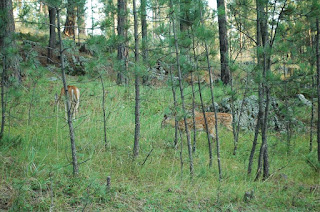
White-tailed doe resting in the cover of a forest

Other Information: The white-tailed deer is one of America’s most popular game animals. Hunted nearly to extinction, due to better game management and habitat enhancement (often incidental to loss of habitat for other species) it is believed that there are more deer now than in pre-Columbian times. White-tailed deer are a nuisance in some areas, destroying crops and ornamental plants, striking vehicles, and overconsuming forest resources due to overpopulation. They are also disease vectors, hosting ticks that carry Lyme disease. White-tailed deer also played an important role historically in the US. Native Americans and European settlers alike used the deer as a source of food, clothing, and tools. White-tailed deer mate in the fall, usually in their second year. Births are usually single or double. Fawns can walk immediately and have no scent. Lack of scent, coupled with camouflage pattern that makes them resemble the forest floor, is an adaptation to protect against predators. When startled, the mother will bolt and leave the fawn(s) behind, triggering a predator’s chase instinct. Bucks grow antlers annually prior to mating season. They will spar with other males, using antlers as a weapon and to impress females. Antlers, which are made of bone, grow covered in velvet, which supplies blood to the growing bone tissue. After the velvet is shed, the antlers stop growing and eventually weaken and break off after mating season ends. Summer and winter coats differ in color, ranging from brown to grayish. The underside of the tail is white and is flicked as a warning signal to others, giving the white-tailed deer its name. White-tailed deer is an ungulate and as such, has a multi-chambered stomach like cows. Food is partially broken down, regurgitated, and digested more completely. This allows the deer to break down tough cellulose in plant material to more efficiently gain energy from it.
Information this month comes once again from University of Michigan’s Animal Diversity Web. 
A mother and two fawns browse in edge habitat.
A buck is behind and uphill.

White-tailed buck (Pennsylvania Game Commission)

Thursday, October 26, 2017

Species of the Month

October’s Species of the Month is another Halloween-related critter, just in time for the spooky holiday. Last year it was the little brown bat; this year we profile the great horned owl. Because they are primarily nocturnal, you are most likely to see one perched in the branches of a bare free, silhouetted against a full moon on a window cling or cardboard cutout decoration. 
Scientific name: Bubo virginianus
Kingdom: Animalia (animals)
Class: Aves (birds)
Order: Strigiformes (owls)
Range: North and South America from northern Alaska to southern Brazil
Habitat: Nearly universal in their range: forest, grassland, desert, swamp, and urban areas
Lifespan: 13 years in the wild, on average
Diet: rabbits, rodents, insects, amphibians, crustaceans, reptiles         
Predators: crows, raccoons (egg depredation)
Conservation Status: No special protection
Owl in a tree, Eatonville, WA

Other Information: The great horned owl is specially adapted for night hunting. The large eyes make efficient use of low lighting, and the round face funnels sound to the ears. The ears are offset, one higher on the head than the other, allowing the bird to locate prey by sound with pinpoint accuracy. Feathers have special edging that make for silent flight. The “horns” are feathers, not ears, and may serve as camouflage. They mate for life, and find each other during hooting rituals. While males hoot all year, females only hoot during mating season. A clutch of one to six eggs per season is the norm, although the number of offspring is dependent on prey density. Great horned owls are one of the most widespread birds, ranging from the polar regions to the tropics. As such, individual diets vary depending on specific habitat and location. Nests generally are someone else’s abandoned nest, such as a squirrel’s. The owls I saw in Washington flew out of a barn when I approached it, and I observed pellets (undigested feathers and bones that are coughed up) and droppings but no nest.

Information on owls comes once again from University of Michigan’s Animal Diversity Web. 
Owlets (Missouri Department of Conservation photo)

Adult great horned own (Missouri Department of Conservation photo)

Thursday, September 7, 2017

Nature Minute Road Trip- Wolves of Yellowstone

Predators are an essential part of a healthy ecosystem. Owls and snakes might be patrolling your neighborhood, keeping the rodent population in check and out of your house. Birds and bats target pest insects. Top-level predators, the large killing machines, are equally important but have suffered from human ignorance. To demonstrate the importance of top-level predators, enjoy the story of the gray wolf and how its return impacted life in and around Yellowstone National Park. This is the first story from the Nature Minute Road Trip. 
Wolves were extirpated (made locally extinct) from Yellowstone in the 1930s. They were a menace to neighboring ranches’ livestock and preying on the park’s more charismatic wildlife like bison and elk. Mind you, this took place before the National Park Service placed much emphasis on the “preservation” part of its mission and focused more on the “enjoyment” part. This was a time of public bear feedings.
Gray wolf (in captivity)
By the time 1995 came around, the elk population had gotten out of hand. After much deliberation, a wolf pack from Canada was transported to Yellowstone. The wolves were carefully selected to ensure that their preferred prey was elk, since that was the target species for culling. Yes, different wolves prefer different prey, but they will switch depending on availability.
Elk

The wolves were placed in kennels to quarantine them and let them acclimate to their new surroundings before being released into the wild. Contact with rangers and biologists was limited so they wouldn’t get used to being around people. After release, the fun began.
With large predators on the loose again, the elk had to adapt. They began spending less time in open areas. Lower elk numbers combined with elk lifestyle changes led to young trees growing. Previously, the elk had eaten nearly all new trees before they had a chance to reach maturity. With new trees like willows growing in the river bottoms, beavers began migrating back to Yellowstone. The new trees, even newer beaver ponds, and lower coyote populations (out competed for food by the larger wolves) brought in a host of birds and small mammals that had left. With the birds came smaller predators like foxes and hawks. 
Wolf being released at Yellowstone (NPS photo)

The leftovers from wolf kills attracted more corvids (ravens, crows, and magpies) and benefited eagles (bald and golden) as well as bears (black and grizzly). The absence of elk in the river bottoms and the emergence of trees there changed the course of rivers by stabilizing the banks. This was a two-fold move. The elk were eroding the banks with their constant trampling and the trees added stability by holding soils and rocks in place.

The wolf reintroduction was not without its critics, people we will call lupophobes for their fear of the wolf. People to this day still deny that the wolf reintroduction has done any benefit for the Greater Yellowstone ecosystem. Science hasn’t proven that all these changes are caused directly by the wolf’s presence, but it does prove that the benefits took place after. You decide. I'd been to Yellowstone before the return of the wolf, but I barely remembered any of it, let alone enough to do a before and after comparison.

This week's wolf information and picture come from the National Park Service.

Wednesday, January 4, 2017

In the zone

Nature loves order. A place for everything, and everything in its place. This week we take a look at zones, nature’s sorting bins.
Every species has its habitat, which is where it lives and what it consumes. It also has a range, which is the geographical limits of where it and its habitat exist. On a more local scale, the habitat and range occur in a zone of an ecosystem.
Even though it’s bitter cold outside (at least where I sit), let’s revisit the beach we explored at Labor Day. We examined the sea creatures one several different rocks. There were many species there: mussels, starfish, anemones, and barnacles just to name a few. They all share the same habitat (beach) and while they may have different ranges (British Columbia to northern California vs Alaska to Baja for instance), at this location their ranges overlap.
Soft-bodies sea life at the lowest exposed rocks at low tide

Hard-shelled sea life in the highest exposed rocks at low tide

But notice that the species on one rock are totally different from those on another, even though they are separated by a distance of just a few dozen feet. The rocks are in different zones. Starfish and anemones are on rocks that are farther away from the high tide line, and those species are more sensitive to the drastic changes in tide. Closer to the high tide line you’ll see the mussels, snails, and barnacles. They are hardier and can withstand exposure to dry conditions much better. Also, notice that those three all have a hard outer shell, while the starfish and anemones don’t. Think there might be a connection between zones and defensive adaptations?
Not all zones are at the beach. Take a drive up to Mount Rainier with me this summer and I’ll show you how the forest changes as we go up in elevation. The dense western red cedar, Douglas fir, and western hemlock give way to mountain hemlock, pines, and Pacific silver fir right on up to subalpine fir scattered throughout mountain meadows. The taller trees are at lower elevations, while higher up the trees are stunted and warped by the short growing season and heavy snow cover. Even the air smells different in the different zones. Marine and aquatic environments also have different zones according to depth and the amount of light that reaches them.
Western red cedar, western hemlocks, and Douglas fir at about 3500 ft above sea level

Subalpine fir at about 5500 feet above sea level

Ocean zones from Marine Biodiversity wiki
http://www.marbef.org/wiki/open_oceans


Zones can change by elevation, depth, and latitude, or a combination. Douglas fir can be found at higher elevations in the southern Cascades than in the northern Cascades. Zones can also change over time, not just space. Forest zones change as trees grow and die, or in the case of disturbances such as fire. Next time you are out and about, look around for changing zones around you!