Translate

Showing posts with label safety. Show all posts

Friday, July 24, 2020

Nuclear Energy

Nuclear energy harnesses the power of the atom to generate tremendous amounts of electricity
from a very small amount or fuel. This controversial source is non-renewable because there is a
finite amount of uranium, and while it produces no carbon emissions it is not “green” because of
the radioactive waste it produces.
Nuclear power plants use the heat created by splitting uranium atoms to create steam either by
boiling water or turning pressurized water into steam without boiling it. The steam turns turbines,
which generate electricity. In both boiling water and pressurized water systems the steam is
condensed back into water to be cycled again. 
Nuclear fission in action
Much of the controversy surrounding nuclear energy is a fear of what could happen. In the years
since nuclear energy plants began generating, there have been three major accidents- Three Mile
Island in 1979, Chernobyl in 1986, and Fukushima Daiichi in 2011. An example of what could go
wrong follows.
Three Mile Island was a loss of coolant accident. A mechanical failure prevented water from
reaching the reactor core to cool it. As pressure began to build in the core, a relief valve opened
as it should have, but remained stuck open when pressure returned to normal levels. Cooling
water poured out of the valve, but plant staff was unaware as instruments indicated the valve was
closed. Without correct information from instrument readings, staff incorrectly reduced the amount
of cooling water going to the reactor, which caused it to overheat. The zirconium cladding that
contained the uranium fuel pellets began to melt. A hydrogen bubble formed inside the containment
dome, raising fears of an explosion and containment breach. Pregnant women and small children
were ordered to evacuate, and there was a release of radiation (done intentionally to relieve pressure)
but not enough to cause any health issues. Plant staff resumed the flow of cooling water and were
able to reduce the hydrogen bubble. The reactor stabilized, and it was discovered that about half
of the core had melted. 
Three Mile Island. The cooling towers for the damaged
reactor are in the foreground. (Lancaster Online)
Safety has improved considerably at US plants. In fact, the costs associated with safety, security,
and permitting have become almost prohibitive to opening new plants. A plant in Tennessee will
be coming online in late 2016, over 40 years after construction began because low demand for
electricity and did not justify the cost of completing the plant until recently.
Aside from safety concerns, spent nuclear fuel is an issue no one is quite sure how to deal with.
Currently, spent nuclear fuel is stored on-site at power plants. First, it is stored in a cooling pool
for a minimum of five years. When it has cooled enough, it is encased in a concrete and steel cask.
However, the material will remain radioactive for thousands of years and a permanent location for
disposal has yet to be found. Reprocessing allows uranium and the resulting plutonium to be reused
as fuel, which cuts down on the amount of waste material but only delays the problem.
Spent nuclear fuel in a cooling pool (International Atomic Energy Agency)
One potential solution to the waste problem is transatomic power, which dissolves nuclear waste
into molten salt, would reduce the amount of spent nuclear fuel by using it again. It also has the
potential to reduce the half-life of waste, or amount of time that it takes for half of the mass to decay
and no longer be radioactive.
Another negative environmental impact of nuclear energy is the potential for radioactive release or
water pollution from tailings at uranium mines. Uranium tailings are radioactive, and may contain
sulfides that can produce acids. Tailings should be placed within an engineered dam and then back
inside the mine when operations conclude (World Nuclear Association, 2013).

After examining various methods of energy production, it has become clear that no source is
completely free of environmental impacts. The negative impacts are wide ranging, from localized
to single windmill to a global scale with fossil fuels. Fossil fuels have been widely panned for the
environmental damage they cause at a regional level for oil spills to the global climate change
linked to carbon dioxide emissions. They have been ruled out as the “greenest” energy, but what
about the others? 
Wind, solar, tidal, and geothermal appear to have the least negative environmental impacts but
can be limited by factors such as geology, topography, and weather. As technology advances, it
may be able to overcome these limitations. An ideal solution to the fossil fuel problem is to
increase their generating capacity and incorporate them into an improved and more efficient grid.
Since these sources, as well as hydroelectric, are mainly regional a better grid would blend all
electricity into a single network that can easily transfer energy to rapidly meet demand. Thus,
hydroelectric from the Pacific Northwest could supply power to Iowa when the wind stops blowing. 

So what is the “greenest” energy? It is all a matter of personal preference and an individual’s
tolerance for the different negative impacts. Bird strikes from wind energy may be a more pressing
concern for some people than fish strikes caused by tidal energy. 

Friday, June 26, 2020

Wind Energy

Wind energy is another “clean” energy using the power of moving air to generate electricity. It is renewable because there is no shortage of air on the planet, and it is constantly in motion to a varying degree. It is not completely reliable because the wind is not always blowing, although the wind turbines are at least 100 feet above the ground to take advantage of the less turbulent and more abundant airflow, as compared to ground level.
Wind farm (US Department of Energy)

Wind energy currently makes up 4% of the US energy mix, but is growing and will eventually pass

hydroelectric as most rivers are dammed to capacity. An ideal place for wind farms in the central US
“Tornado Alley” because of nearly constant strong wind. Wind farms are compatible with the
traditional farms of the region and are an economic boon for farmers. They can lease land to energy
companies for windmill placement, and still have the ability to use nearly all of their land. Ridge tops
in the Appalachians are another great location, where topography produces adequate wind speeds.  
Developing technology has greatly improved the efficiency of windmills. Lighter blades, taller towers,
and control systems have increased the average capacity factor from 22% in 1998 to 33% in 2014. As
the race to replace fossil fuels continues, expect efficiency to increase further.
The downside to wind energy, aside from lack of wind, includes environmental impacts. Construction
of windmills in undeveloped areas requires access roads and site preparation, which can be a strain on
the environment. Leaking lubricants can pollute the soil. Birds and can be struck and killed by
windmill blades. However, fewer birds are killed by windmills than stationary buildings. Many birds
are learning to avoid areas containing windmills. Tornado Alley windfarms are away from major
flyways so migratory birds are less likely to affected in that region.
Birds and windmills are not always a good mix (NBC News)
Other negatives are aesthetics and safety. Many people believe the windmills are unsightly and ruin the
landscape. One workaround for that is to install them in developed areas, where they might actually
improve the view, especially if the view is mainly housing developments and shopping centers.
The focus then shifts to noise. The rotating blades can be noisy, depending on the distance from the
listened but the elevation above the ground helps reduce that.
Safety can be an issue when rotating blades are involved. Machines malfunction, and should a windmill
throw a blade, the potential for human death is there. A serious concern in Tornado Alley is that a
namesake tornado could destroy a wind farm and turn the blades into deadly projectiles.
This week's information comes from National Renewable Energy Laboratory, Mount Holyoke College, and US Department of Energy. Next week we'll take a look at solar energy.

Thursday, October 3, 2019

Be Bear Aware

With the arrival of fall and the approach of winter, food sources are becoming scarce for some animals. Bears spend the winter either hibernating or in torpor, a state of lowered metabolic and other bodily activities. To prepare, they begin gorging themselves this time of year so they can have enough calories to last through an extended period of not eating. While they generally try to avoid humans, now and when they emerge in spring (very hungry) are the most likely times you will encounter a bear. Here are some helpful tips on how to avoid or survive a bear encounter.
Don't let this happen to you! (US Forest Service)
Hungry bears are attracted to food and will follow their noses. When camping, store food, drinks, utensils, cookware, dishes, cosmetics, and hygiene products in a bearproof container, locked in a vehicle, or suspended 10-15 feet above ground and 4 feet on all sides from a climbable surface. Sleep in a tent or camper away from your cooking area. Don't sleep in clothes you cooked in. Don't set up camp near berry patches, carcasses, and bear signs. Avoid foods with a strong smell like bacon and fish, no matter how good they are. Sleep near your flashlight and bear spray. If you see a bear try scaring it away by making loud noises. If it is undeterred, move away to a safe area.
Ideal camp setup (WildAware Utah)
When hiking, if you see a bear that hasn't noticed you, move away quickly, quietly, and calmly. Never try to run from a bear. Running might trigger the chase instinct and the bear will always beat you in a race. If you see a bear and it notices you, let it know that you are human and  not food or another bear. Talk to it calmly, move your arms about, and keep an eye on it without making eye contact. Hopefully the bear will leave. If it does, walk away in a different direction. If it remains, back away slowly but keep making small talk. If the bear approaches you and is acting defensively- making loud noises moving its head around, or stomping or pawing at the ground, stand your ground. If the bear approaches, it's probably bluffing. Keep talking calmly to it, and start backing away when it stops coming at you. If it comes at you again, stop moving but keep talking until it stops again. If it attacks you, now is the time to play dead. Face down on the ground, keep your backpack on if you have one. If the bear rolls you over, keep rolling until you are face down again. Otherwise, don't move and don't make any sound until you're sure the bear is gone.
If you are faced with a quiet bear that won't leave, you'll probably have to fight the bear or at least make it think you want to. If backing away doesn't keep the bear from you and it is behaving calmly, act aggressively to let the bear know that you are not an easy meal. Yell at the bear, make yourself appear as large as possible, throw things at it, swing a large stick at it, and make eye contact. The idea is to make the bear think that since you are crazy enough to fight a bear, it probably shouldn't be messing with you. If the bear decides to attack anyway, fight back with a focus on its face. If you have bear spray, use in situations where the bear is aggressively approaching you. Make sure you are not spraying into the wind, and don't spray it on yourself as a repellent. Read the instructions.
The reason I chose bear safety this week is because I just had my first bear encounter while camping in Virginia. I was tent camping about 30 miles south of Washington, DC and while I got up to use the bathroom at 1 AM a bear took advantage of my absence and ransacked my campsite. It put some holes in my tent, knocked my cooler off the picnic table, and tipped over my folding chair. What did I do wrong? I had my alarm set for 5:30 AM so I could catch an early train into the city. To move more quickly, I had my next day's clothes and my toiletries in the tent with me. That was my first mistake. My second mistake was leaving the cooler in the open. I had 8 bottles of water and 3 glass bottles of root beer in there. I decided the ice would last longer in the woods than it would in the car when drove into civilization, where it's generally hotter. My third mistake, which wasn't really a mistake but just the circumstances, was not having safety in numbers. Bears don't like people; we have a bad reputation in the animal world. Being off-season in the middle of the week, the campground was pretty much empty. With no people around, maybe the bear felt like the campground was OK to stroll through, and the only tent around was an easy target.
Holes in the tent were on the right side, so I'm guessing
the bear moved right to left, swatting the chair over for
dramatic effect.
When I came back to the campsite, the bear was gone. The tent was a heap, so I spent the rest of the night in the car with the doors locked. Yes, I've seen a news article where a bear gets in a car and steals it.  After sunrise, I inspected the damage. There were holes in the tent, nothing too big but they'll only grow each time the tent is set up. None of the drinks were opened and the glass bottles didn't break. Despite their superhuman strength, bears still need you to open a bottle for them. The chair was fine, but I have no idea why the bear decided to flip it. With a damaged tent, I ended my trip a day early. This week's bear safety tips come from the Grizzly and Wolf Discovery Center right outside fabulous Yellowstone National Park.

Thursday, May 9, 2019

Cave Life

This week is Cave Week, so to celebrate we're going spelunking to see what critters we can find. In addition to all sorts of whimsical formations, caves host a surprising amount of life. There are trogolobites, which live full time in caves; trogolophiles, which live in a cave but can also survive outside; and trogoloxenes, the part time cave denizens. You can encounter insects, fish, birds, mammals, plants, fungi, and others. Because there is very little natural light, many of these species are adapted to live in darkness; some don't even have eyes.
Whimsical cave formations

The first cave critter that comes to mind is a bat. Many bats roost in caves because they are cool and dark during the day, making it easier to sleep. Caves make a great place to hibernate over the winter. A constant temperature that is above freezing is an obvious plus, but it's cool enough to trigger the hibernation process. Other cave mammals include bears and jumping mice.
To the bat cave! (National Science Foundation)
Plants are a rare find in  caves because they need sunlight for photosynthesis. I saw ferns growing in a cave under a ceiling hole that opened to the surface. Much more common are fungi, which thrive in dark, damp conditions. Most important among them is Pseudogymnoascus destructans, which causes White Nose Syndrome in bats. It is devastating bat colonies across the US and Canada, and enjoys the cool temperatures while the bats hibernate.
White Nose Syndrome affecting these bats (NPS)
Cave fish are interesting little critters. Nearly all lack eyes and skin pigment. With no light to see by, there is no need to camouflage or stand out, so they are likely to be white or light colored. Unable to see their food, they find it by sensing movement in the water. What exactly do they eat? Since plants, the base of the food chain can't really live in a cave, anything in there either needs to go outside for good or eat whatever gets brought in. Cave fish eat detritus that washes in during rain events. Other critters get by on dung, the leaving of larger animals that way out.
Blind cave fish (NPS, Rick Olsen)
Cave Week runs through this weekend. Find a cave near you and check it out. Spelunk safely. Use the buddy system, carry at least three light sources, and make sure someone knows where you are going. Don't disturb any wildlife and make sure clothing and equipment are thoroughly cleaned before entering another cave. This helps prevent the spread of White Nose Syndrome.
This week's information comes from the National Park Service and National Geographic.


Friday, July 6, 2018

Species of the Month

This month’s species of the month celebrates independence with America’s newest national symbol, the bison, which became the national mammal in 2016. For the Plains Indians, the bison meant life. To me, it represents strength, power, and resilience as it was hunted nearly to extinction but has since recovered to an estimated population of 31,000 wild bison. While it’s a far cry from the tens of millions roaming the prairies and woods in the 19th century, it is much better than the thousand or so that remained in 1889. 
Bull bison at Yellowstone


Scientific name: Bison bison
Kingdom: Animalia (animals)
Class:   Mammalia (mammals)
Order: Cetartiodactyla (even-toed ungulates)
Grazing bison
Range: Historic range runs from Alaska and northern Canada west of Hudson Bay south to northern Mexico, Intermountain West east to the Appalachians. Current range is limited to national parks and preserves, private wildlife conservation areas, and private ranches scattered about the US, Canada, and Mexico.
Habitat: Forest and/or prairie habitat; can be found in tallgrass, shortgrass, or mixed grass prairies
Lifespan: 15-20 years
Diet: grasses, sagebrush
Bison herd at Custer State Park in South Dakota.
The orange colored calf is known as a "red dog".
Predators: wolves, mountain lions, humans
Conservation Status: Listed as near-threatened due to reliance on conservation for survival by IUCN. Listed as endangered under ESA.
Other Information: Bison were long a source of sustenance for the Plains Indians, who used every part of the body for food, clothing, shelter, and tools. They were hunted nearly to extinction in an effort to subdue the tribes that depended on them. Of the roughly 31,000 wild bison, only a small percentage are purebred. The rest are hybridized with domestic cattle. Wild bison herds are scattered throughout the West. Notable herds are found in Yellowstone, Wind Cave, and Wood Buffalo National Parks. There are two subspecies of bison: the familiar plains bison and wood bison, which lives in northern forests of Alaska and Canada. Bison grazing influenced plant communities, which in turn affected what other animals lived in the ecosystem. Bison form segregated herds based on age and sex. Male herds are smaller than female herds, although more males will join as the rut approaches. The rut happens in late summer/early fall. A dominant bull controls a female harem, and younger bulls will challenge him. A bison’s shoulder hump is a mass of muscle that helps support the large head. The giant head works as a snow plow in the winter, clearing snow off the grasses. Despite their docile appearance, bison are capable of inflicting serious damage. They are fast- they can run up to over 30 miles per hour and have no problem using their horns. Keep your distance.
Resting captive bison in Washington


Lamar Valley bison at Yellowstone

Lamar Valley bison at Yellowstone


This week's information comes from University of Michigan's Animal Diversity Web, The Nature Conservancy, US Fish and Wildlife Service, and Environment News Service

Wednesday, June 27, 2018

Thunderbolts and Lightning, Very Very Frightening Me!


Summer is here, the time of lazy days, high heat, fireflies, and of course, thunderstorms. Thunderstorms can happen anywhere at any time, but are most likely to happen when it gets hot. Here in the east where I live, my thunderstorms are most frequently in the late afternoon. In the Midwest, they usually happen in the evening or overnight. Where do these storms come from?

There are two ways for a thunderstorm to form that I’ve noticed. The first is associated with a cold front. Usually, what I’ve seen is we’ll be in a heat wave (three or more days of temperatures above 90̊) and when a cold front comes in to cool things off a bit, the contrast between very hot and less hot air causes enough atmospheric instability that severe thunderstorms form all along the front.
Afternoon thunderstorm building over Pennsylvania
The other situation, and this is my favorite, is what I call the pop-up storm. These happen later in the day and form when the heat and humidity of the day force hot air to rise. As the air rises it cools and condenses into clouds. If the cloud gets tall enough, the water vapor molecules eventually for ice crystals. If the ice crystals collide with each other, they can create an electrical charge. The electrical charge is lightning. A bolt of lightning is hotter than the surface of the sun and causes the air around it to superheat. The rumble of thunder you hear is the sound of superheated air expanding.
Anvil cloud from a dissipating thunderstorm
Lightning is lazy. When cloud-to-ground lightning strikes, it looks for the shortest and easiest path to the ground. That means the tallest object around. Being in a flat, open area (such as a beach, the rim of the Grand Canyon) or on a prominence such as a hill or mountain makes you a target. Avoid those areas. Also, stay away from tall objects like trees. Get out of the water when you hear thunder. A good rule of thumb is if you can hear thunder, the lightning is close enough to hit you. Pretty much anything indoors is a safe place to hide from lightning, as long as it’s not made completely out of metal.
Lightning strikes near Crater Lake
Another way for thunderstorms to kill you is with a flash flood. Don’t try to drive through water on a roadway. Listen for a rushing sound if you’re hiking in a canyon and move to higher ground. Even if it’s not raining where you are, a flood from rain upstream will find you so be aware of local weather conditions.
A pair of storms approaches in Wyoming
Hail sometimes accompanies a thunderstorm. While it can be cool to see everything covered in ice during the summer, large hailstones can cause property, crop, and people damage. An umbrella won’t protect you from a frozen baseball that’s been falling for thousands of feet so get inside. Also, hail is an indicator of possible tornadoes. Refer back to this post from March.
Odds are pretty good you’ll survive the next thunderstorm. Take the time to relax by listening to the sounds of the rain and thunder. Appreciate all the complexities and nuances that go into making nature’s rumbly light show.
This week's information comes via the National Severe Storms Laboratory All photos are my own.

Thursday, June 14, 2018

Road Trip Adventure- Behind the Scenes


Last week I shared pictures, video, and information about the horseshoe crab. This week we take a behind the scenes look at the adventure. While the trip to Delaware wasn’t as tedious as a National Geographic photo shoot (they might spend three months to get that one shot you see in the magazine), it wasn’t the figurative walk on the beach that it literally appeared to be.

Welcome to the second smallest state!
(Delaware Business Times)

The biggest question mark I had to deal with was weather. The forecast was for thunderstorms. Fortunately my daughter and I dodged those. I wasn’t about to head to the beach during a thunderstorm. Your happiness, gentle reader, is not worth my life. It was cloudy that night, and I wasn’t sure if it was the moon itself or just the tides associated with the moon that draws the crabs to the beach. Apparently, it’s the tides and not moonlight. 
Rain was our closest companion during the weekend. I was hoping to get daylight shots at noon’s high tide the Saturday we were there. However, threatening clouds were on the horizon and with more thunderstorms in the forecast I decided to bag it. We managed to get another trip to the beach at low tide, where a few stragglers were going back out to sea. There were also a few dead crabs below the wrack line, some birds, and a shopping bag full of garbage. Saturday night rain kept me awake and at some point during the night the tent decided it was too wet to hold the water back any longer.
And they were right (Pintrest)
Camping in the rain can be a miserable experience, but our second closest companion, at least while we were in camp, was the mosquitoes. They helped me set up the tent by encouraging me to do it faster. They even managed to get inside. They got in the car. They visited me in the bathroom. They were undaunted by the rain. I learned how foolish I was to believe that they lost their taste for me over the years. East Coast mosquitoes will surely beat West Coast mosquitoes in a street fight any day.
Business was booming at the 24 hour buffet
(End Times News)
With rain, you are sure to have humidity. My hair is too short to get frizzy, but that wouldn’t bother me. The bother was driving into camp, to the beach, and back to camp without being able to see anything. Nothing I did could stop the humidity from fogging up the windshield. If it wasn’t the foggy windshield on Friday night it was the actually foggy fog. How humid was it? I had a box of graham crackers (we had raw smores because of the rain) stored in my cooler (no ice) and the cardboard still managed to get soggy, despite the outside (and inside) of the cooler staying out of the rain. I’ve never seen humidity like it.
All this complaining is to remind you that fieldwork has its discomforts. Even though all I did this time was observation, we do this in all conditions. Always keeping safety in mind, research and fieldwork go on despite nasty weather. Obviously, sometimes conditions make it impossible to get the job done. I can’t count frog eggs in the rain because the surface ripples make it impossible to see any eggs below. I won’t be pulling invasive weeds when there’s a foot of snow on the ground. Sometimes conditions interfere with natural processes we’re trying to observe. Insects won’t be around much on a windy day. A cool, cloudy day will keep reptiles away. So we wait. And that’s why your National Geographic picture is three months in the making.

Thursday, March 29, 2018

Not in Kansas Anymore


Spring is in the air. The return of warmer weather also brings thunderstorms and the start of tornado season, so there's a lot more in the air than just spring. You might associate tornadoes with places like Kansas or Oklahoma, but tornadic activity usually starts in the South in early spring. By May or June, the center of activity moves west to the Lower Midwest, then shifts to the Upper Midwest for June and July. However, tornadoes can strike anywhere at any time. The previously mentioned periods are just the most likely times and locations. Here’s some information about this swirling vortex of death.
Swirling vortex of death (National Weather Service)

The current theory on how a tornado forms is that differing wind speeds during a thunderstorm cause horizontal rotating air columns. If the air column gets caught in an updraft it changes orientation and becomes a vertical column. If the column touches the ground it’s a tornado; otherwise it’s just a funnel cloud.
Tornadoes primarily form in supercell thunderstorms, which are large rotating thunderstorms. Tornadoes will likely drop from a feature of the storm called a wall cloud, which is large low-hanging cloud to the rear of the area of precipitation. It’s far easier for ground spotters to in the Midwest to see wall clouds and storm rotation from a distance than it is for those in other areas.
Wall cloud (National Severe Storms Laboratory)

Having lived in Pennsylvania and Washington all my life, there is no clear horizon in my areas. There are trees, mountains, and buildings in the way. I could tell if a storm was coming based on the clouds in my immediate area. Driving across northern Wyoming, I could see a pair of thunderstorms miles away and the precipitation was visible long before I caught up to it. I didn’t see any rotation or wall clouds, but I was also focused on the road.
Signs to look for during a potentially tornadic thunderstorm are hailstones, green clouds, rotating and/or low hanging clouds, and the loud roar of a freight train. If you observe any or all of these signs, seek shelter immediately.
Another twister (National Severe Storms Laboratory)
Tornado safety
When a tornado watch is issued, it means conditions are favorable for tornado formation. A tornado warning is issued when radar indicates rotation in a storm or a tornado has been seen by a spotter in the field. If a tornado warning is issued, seek immediate shelter. The best place to be is in a basement, but absent that use the downstairs area of a building. A windowless room is best. If there is no windowless room, stay as far from windows as possible. If you can, get under a sturdy table or cover yourself with heavy blankets. If you’re in a high rise, seek shelter in an interior hallway on the lowest floor possible. If outdoors, try to get inside. If you can’t try a vehicle. Buckle up and cover up. Lying in a ditch or depression is also a viable option. If driving, don’t try to outrun a tornado.
This week’s tornado information comes from the National Severe Storms Laboratory and University Corporation for AtmosphericResearch. Safety tips come from Ready.gov.

Friday, November 3, 2017

Live Streaming

After so many stories from the road, this little story about one of my last events in Washington got shoved aside. I spent some time in Percival Creek with the Thurston County Stream Team conducting a stream bug survey, also known as a biological index of benthic invertebrates (BIBI). File this under “Things I wasn’t allowed to do 30 years ago”.

Stream bug monitoring is an important way to gauge the health of a stream. Some thrive in polluted water, some thrive in pristine water. To know how many of which kinds of insects are in the stream is a good indicator of water quality. Just what is a stream bug? The ones we looked for are actually the larvae of insects such as mayflies and caddisflies. The larvae are aquatic, living in freshwater, making a living in a variety of ways such as scrapers and shredders.

The method used by my group was to sample three areas within a riffle of the stream. A riffle is an area of faster moving water. Our leader, Debbie Smith, is the coordinator for Tumwater Stream Team. She supplied us with all the necessary equipment, minus our own boots. To collect samples, we used a funnel-shaped net that had a metal square at the front which marked the boundary of the sampling area. A weed fork is a great tool for the stream to, scaring up bugs on the rocks and in the substrate by rapidly mixing it around inside the metal square. Debbie also brought a stop watch, buckets, insect field guides, and lab equipment including magnifying glasses, headlamps, forceps, and sealed containers. While we began collecting samples, Debbie stayed behind with one other from our group to set up the lab. 
Net similar to the one we used for sampling. The front section defines the sampling area.

Weed fork

After washing our boots in a mild chemical solution, we took turns mixing up both the surface and substrate of the stream bed for a minute, loosening the bugs which then flowed into the net with the current. Large rocks in the square went into a bucket for analysis. Stream width and depth at the sample sites, as well as the length of the sampled riffle, were recorded for each sample. Distilled water (to prevent outside bugs from being counted in the sample) was used to rinse any bugs on the net into the collection bag at the bottom. 
Example of stream bugs clinging to a rock

Processing samples in the lab (Debbie Smith photo).

Our samples were taken to the lab for analysis. Our lab was a simple setup on a bridge that day. Small rocks in the collection bag were removed and inspected. Any bugs were removed with forceps and placed in alcohol for later analysis by entomologists that can ID them by genus and species. The same was true for the large rocks in the bucket. The collection bag was emptied and scoured for bugs. Rocks were not sent to the entomologists, but any organic matter in the net, such as leaves and woody debris, did go along with the insect samples. We did this at three different riffles, for a grand total of nine minutes of churning up creek bed.


We did our survey in because stream levels are low. If the water is too high, the bottom is unreachable and the current can be dangerous. There were always at least four of us in the water: one holding the net, one using the weed fork, one running the stopwatch, and one holding the bucket of rocks. If anything happened to one of us, there was always someone available to help. Always think safety in the lab and in the field. 
Stream Team following a successful morning of splashing around
Percival Creek. I am 4th from the left in the green shirt.
(Debbie Smith photo)

Thursday, August 17, 2017

The Cosmic Ballet Continues

This Monday the United States will witness the rare and majestic total solar eclipse. Not all areas will see a total eclipse, but all of North America will see at least some of the sun disappear. While not a rare event, it is unusual for a total solar eclipse to cover such a large populated area. It seems like usually they happen only over the remotest part of the Pacific Ocean or exclusively at the South Pole. This eclipse will the first total solar eclipse to hit the US since 1979. That might not be too terribly long ago, but think about this: in 1979 there were still people alive who could remember the last time the Chicago Cubs won the World Series (1908) or fought in the war against Spain in 1898.
What is a solar eclipse? When the moon passes between the sun and Earth and casts a shadow on us, that’s a solar eclipse. They can only happen during a new moon, which is when the sun’s rays hit fully on the “dark side” of the moon, so it’s the only time you’ll ever see a new moon. New moons happen every 29 days, just like a full moon, but we don’t have a solar eclipse every month because of how the sun, moon, and Earth dance with each other.
Geometry of a solar eclipse- not to scale (from Nustem)

You’ll notice the sun is a lot higher in the sky now than it was in January. Because Earth is tipped about 23̊ as were orbit the sun while spinning in our tipped circle (which also wobbles) the sun appears to ride a squashed and stretched figure 8 across the sky called the elliptical. The moon does the same, but their ellipticals don’t always match. When they do, you get an eclipse.
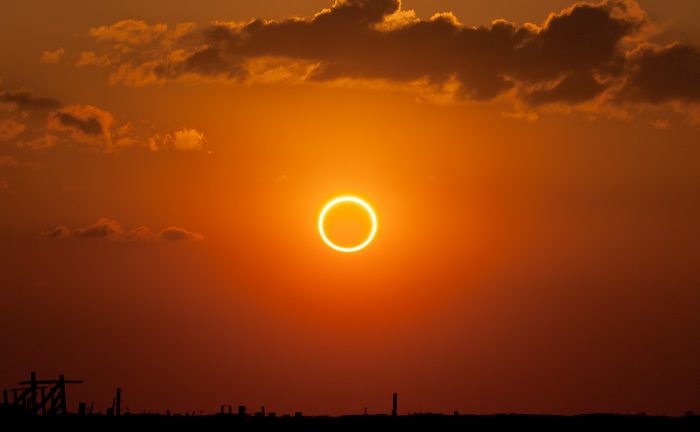
Distance is also important. Neither Earth’s orbit nor the moon’s is circular; both are slightly elongated (an ellipse, hence the term elliptical) so sometimes the moon close enough to block out the sun during an eclipse and sometimes it fits inside the sun like a ring. This is called an annular eclipse. Like during a total eclipse, only a narrow band will see the annular eclipse, while everyone else gets to see a partial eclipse or nothing at all.
Annular eclipse (from Universe Today)

Partial eclipse (from Huffington Post)

Always practice safe eclipse viewing! Follow these tips from NASA. Never look directly at the sun, even during an eclipse. The only exception is during totality, and that is ONLY if you have totality where you are at, and it only lasts about a minute and a half. Use eclipse glasses- if you put them on and try to see anything but the sun, you should only see blackness. Sunglasses will not do the job. Never look at the sun through binoculars or a telescope, unless you have a solar filter. If your solar filter screws on to the eyepiece, it is junk- throw it away! If you don’t have any safe viewing equipment, make a pinhole viewer by poking a hole through a piece of cardboard and let the sun shine through. During the partial phase, you will see a spot of sunlight missing a chunk in the middle of the cardboard’s shadow.

I will be in Salem, Oregon for the eclipse, immediately preceding a very special Nature Minute road trip. Sorry, no live-blogging. I can’t blog while driving, and besides, there’s no wifi in the wilderness. Check back in September or follow along on Facebook for pictures and tales from the road.
This week's credits: Nustem, Huffington Post, Universe Today, and NASA