Translate

Showing posts with label mortality. Show all posts

Thursday, December 5, 2019

A Breath of Fresh Air

If you like fresh air, you're probably a big fan of the Clean Air Act and its amendments. While the air in many places is far from ideal, prior to federal legislation it was downright deadly in American cities. A clear gray sky on a summer's day in Philadelphia is a little off-putting, but it beats a smothering fog in the valleys outside Pittsburgh. After the deadly Donora smog in 1948 killed 20 and sickened thousands of others. Federal investigators were asked to come in, and determined that air pollution was in fact the killer, among other factors.
Donora smog, 1948 (Smithsonian)
The government prefers to take baby steps when implementing positive change, rather than jumping in feet first, and tackling air pollution is no exception. The first step came in 1955 with the Air Pollution Control Act, which provided funding for research and led to the Clean Air Act of 1963 and Air Quality Act of 1967. These provided the first air quality monitoring.
Pittsburgh in the 1940s (Citylab)
The Clean Air Act of 1970 was a major step forward. It developed limits on pollution and expanded federal enforcement powers. Among the controls included were auto emissions. States were mandated to implement plans to reduce pollution.
The Amendments of 1990 aimed to reduce air pollution linked to acid rain and ozone depletion.
Looking at a picture of the summer sky over Los Angeles, it might be hard to believe the Clean Air Act is working. However, the number of ugly sky days is lower than prior to enactment. Air quality monitors in California frequently show poor quality, and geography is partly to blame. Ocean breezes carry pollution as far as the mountains, where it gets stuck and sometimes builds up for days.
Los Angeles skyline (LAist)
Acid rain has been reduced as a result on the 1990 amendments. pH testing has shown freshwater pH levels in many areas have risen closer to neutral 7. Pure water is neutral, but in nature, water is rarely pure. Pristine rain is slightly acidic because of carbon dioxide in the atmosphere forming carbonic acid. However, the lowered pH in rivers and lakes nationwide was far lower than caused by carbonic acid. Targets of the 1990 amendments were nitrogen oxides (NOx) and sulfur dioxide (SO2). Emissions have been greatly reduced over the last 30 years, and ecosystems are continuing to slowly recover.

Visuals of higher pH meaning less acidic water samples
(National Atmospheric Deposition Program)

Information this week comes the EPA (Clean Air Act overview), Smithsonian Magazine (Donora), and more EPA (acid rain). For a great visual on showing higher pH and lower NOx and SO2, check out the National Atmospheric Deposition Program.

EPA: https://www.epa.gov/clean-air-act-overview/evolution-clean-air-act
Smithsonian: https://www.smithsonianmag.com/history/deadly-donora-smog-1948-spurred-environmental-protection-have-we-forgotten-lesson-180970533/
EPA: https://www.epa.gov/airmarkets/acid-rain-program
nm1 LAist: https://laist.com/2018/10/30/why_las_smog_has_been_extra_smoggy.php
nm2 Citylab: https://www.citylab.com/design/2012/06/what-pittsburgh-looked-when-it-decided-it-had-pollution-problem/2185/
nm3 Smithsonian
nm4 National Atmospheric Deposition Program http://nadp.slh.wisc.edu/data/animaps.aspx

Thursday, January 10, 2019

Wisdom of the Ages

While it’s cold and snowy where you are, it’s a warm sunny day on the Pacific atoll of Midway Island, where mating season just ended for the Laysan albatross. Most famous of these large seabirds is Wisdom, the oldest known wild bird. She’s at least 67 years old and still laying eggs. Being that old and still raising young makes me wonder just how long these birds can last.
Wisdom’s age was discovered in 2002 when her band was replaced. The biologist who replaced her band looked up her number and noticed that he originally banded her in 1956, and at that time she was an adult of at least 5 years old.
Wisdom (right) and her mate during nesting season (USFWS)
What is remarkable about this particular bird so special, at least to me, is that she managed to survive so many threats in her time, beyond the normal dangers like predators, disease, and typhoons. Working in her favor are the Migratory Bird Treaty and the US Wildlife Refuge System, protecting her and her kind from human predation and habitat loss at their nesting sites on Midway.
Working against Wisdom and other albatrosses are a whole host of man-made problems. Foremost among them is ocean plastic. Laysan albatrosses feed at night, and their food is fish, squid, and fish eggs that come near the surface. Sadly, floating garbage is also at the surface. In a tragic sequence of events common to marine life everywhere, they mistake plastic for food and either eat it themselves or feed it to their chicks. Despite having full stomachs, the birds and other critters die of starvation because plastic is not very nutritious.
Invasive species are also beginning to take a toll on the albatrosses. They have already been extirpated from the Hawaiian Islands, outcompeted or outright killed by the dogs, cats, pigs, and rats that accompanied Europeans as they traversed the Pacific. Now, the Midway colony is under attack by mice. While the birds are much larger than the mice, they succumb to bite wounds rather move to a mouse-free area because of their dedication to their eggs. US Fish and Wildlife Service is working on eradicating mice from Midway, but having lived with them for thousands of years I think we all know how well that will work out.
Mouse attack victim (Audubon)
This week's information comes from the US Fish and Wildlife Service and the National Audubon Society 


Thursday, May 24, 2018

Species of the Month


This month’s species of the month was supposed to be a lichen called lipstick cladonia, but for being a widespread lichen there is very little information about it. So I changed it to something a little easier to research. This past weekend I saw my first eastern bluebird, so that’s what you get this month.
Scientific name: Sialia sialis
Kingdom: Animalia (animals)
Class:   Aves (birds)
Order: Passeriformes (perching birds)
Range: east of the Rockies from southern Canada to Honduras
Habitat: open areas with trees  
Lifespan: 6-10 years, mortality highest in first year
Diet: primarily insects, also seeds, nuts, and berries
Male bluebird with a cricket (Audubon Field Guide)
Predators: Snakes, house cats, raccoons, black bears, American kestrels. Flying squirrels and chipmunks are egg predators. House sparrows and European starling kill bluebirds and/or compete for nesting sites.
Conservation Status: no special protection
Male with brilliant blue on full display (Smithsonian)
Other Information: Bluebirds are a social, yet territorial bird. At times they gather in flocks, but will also defend a nesting territory and feeding territory from other bluebirds. They also have an interesting dynamic with tree swallows. Two pairs of bluebirds will not nest in boxes that are next to each other, and bluebirds will drive away tree swallows if only one box is available. However, placing two boxes side by side will allow the bluebird and the swallow to coexist as neighbors. Male bluebirds have a brilliant blue backside and red breast; females are dull gray with brownish breast. Her eggs are blue, but sometimes white, in clutches of 3-7. Eggs hatch after 13-16 days and the young fledge nest 2-3 weeks after hatching. Pairs may mate twice in a season, and sometimes the young from the first clutch will help raise the second clutch.
Female bluebird looking with muted colors (Cornell Lab of Ornithology)
Information this month comes from the good folks at University of Michigan's Animal Diversity Web again.

Monday, July 3, 2017

Species of the Month

Celebrate America with July’s Species of the Month. An American icon, the bald eagle is synonymous with freedom and power. Looking at them through a naturalist's eyes, they are also a symbol graceful elegance, keen vision, and superb scavenging skills.
Eagle in flight over Puget Sound
Scientific name: Haliaeetus leucocephalus
Kingdom: Animalia (animals)
Class: Aves (birds)
Order: Falconiformae (daytime birds of prey)
Range: Subarctic North America south to Mexico
Habitat: Large trees typically near water (freshwater or saltwater)
Lifespan: 15-19 years
Diet: fish (freshwater or saltwater), water birds (murres, herons, geese, etc), squirrels, voles, otter pups, rats, carrion, human garbage          
Predators: Adults not subject to predation; eggs and young are preyed upon by bears, raccoons, wolverines, bobcats, foxes, gulls, and corvids
Conservation Status: Species of least concern
Bath time (Photo by Ken Sutliff)

The intense gaze (Photo by Ken Sutliff)

Other Information: The bald eagle has been the US national symbol since 1782, despite objections from Ben Franklin. Listed as endangered in 1978, populations have rebounded dramatically and it was delisted in 2007, an Endangered Species Act success story. Some eagles are migratory, others are year-round residents, depending on location. In addition to hunting and scavenging, some will steal food from other species, particularly osprey. Bald eagles have a long lifespan. Eggs have a low success rate but one-year mortality rates are low. They mate for life but may take a new mate after one dies. Mating rituals include death-defying aerobatics. Bald eagles go through several color morphs before maturing into baldness at age five. Immature bald eagles are frequently confused with golden eagles. Bald eagles are extremely shy and will avoid humans as much as possible. I have a hard time sneaking up on them to get close enough for a good picture.
A whole pile of bald eagles over Mashel River in Eatonville, WA
This week’s information comes from University of Michigan’s Animal Diversity Web: http://animaldiversity.org/accounts/Haliaeetus_leucocephalus/ and special thanks to Ken Sutliff for the bald eagle photos.

Saturday, May 6, 2017

Plight of the Bumblebee

Let’s talk about bees. When I was a kid it took me years to learn not to run around outside barefoot. After countless bee stings, I finally got the hint. Of course, I wanted every bee to die as revenge. Then one day I realized no bees, no honey. Now that I’m older and wiser I realize it’s much bigger than that. No bees, no food.
Bee pollinating pearly everlasting flowers


Bees are small animals but vital not just to ecosystems but to civilization as we know it. For a critter that has the weight of humanity on its shoulders, you would think that these busy little workers would be better protected. Worldwide, bee populations are plummeting. No one sure what is behind the die-offs, but the leading suspects are pesticides and disease, coupled with habitat loss of course.
According to the EPA, the suspected causes of Colony Collapse Disorder (in which the workers leave the hive- the queen and larvae remain with an adequate food supply) are: the invasive varroa mite, new and emerging diseases, pesticides applied to crops or in-hive for mite control, stress from transporting hives, habitat degradation, poor nutrition, and immune-suppression caused by one or more of the previous listings.
Honeybee (from Finger Lakes Land Trust)

In Europe, neonicotinoid pesticides have been banned because of the harm to the bees (The Guardian). America has yet to follow suit. You may be wondering how bees can lose habitat. Well, bees are just like everyone else in the world. They need a place to live, food to eat, and a lack of stuff that kills them. When that field or forest gets converted into "New Townhomes Starting In The Low 200s!" it isn’t just deer and birds that are displaced. Not every bee hive is under your eaves or inside your Mustang’s engine.
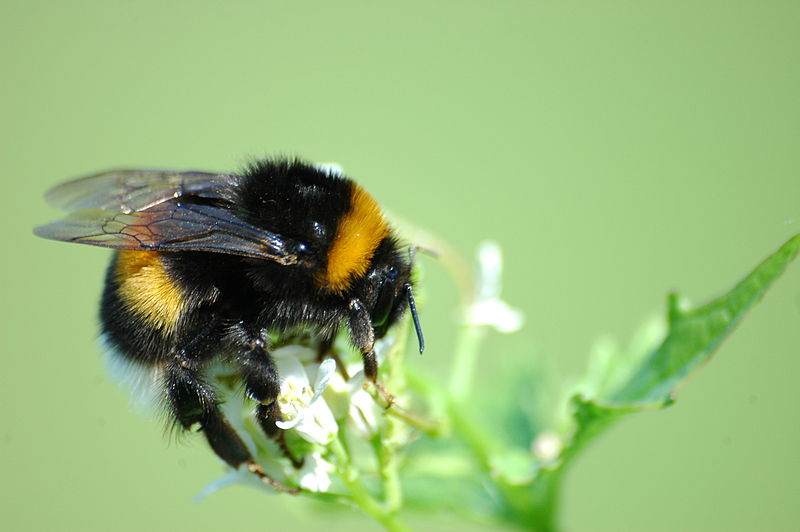
Bumblebee (from keywordsuggests.com)

How can you help the bees? Plant flowers. Native flowers are best because the native bees are attracted to them, they support other native wildlife, and they are low-maintenance because they are adapted to the local climate. Not sure where to start? Ask your local National Wildlife Foundation Habitat Steward (like me) for help.
Mason bee (from Gardeners Supply Company)


Fast fact: There were no honeybees in the Americas before they were brought from Europe.
This week's sources:
EPA: https://www.epa.gov/pollinator-protection/colony-collapse-disorder