Translate

Showing posts with label black-footed ferrets. Show all posts

Thursday, May 2, 2019

Species Recovery

The  Endangered Species Act of 1973 was passed to protect plants and animals that are considered at risk of extinction. The ultimate goal is to recover populations to a sustainable level. How is this achieved?
The first step is to study the situation. Without knowing why a species is in decline, it may be difficult to figure out how to save it. The end result of studying would be a recovery plan.
Recovery plans outline what needs to be done and how to go about doing it. One key component is identifying and protecting critical habitat. Without having adequate habitat there is no way to protect the species.
Rare California condor, flying in the wild again since 1996
(NPS)

There are a few ways to recover a species. The most obvious is to prohibit killing it. Putting a stop to human-caused deaths is the first step in halting population decline.
Captive breeding programs allow for populations to increase in a controlled environment, free of the hazards found in the wild. The trick is not letting the critters you're raising become accustomed to humans. In the case of whooping cranes.
A human disguised as a whooping crane teaching actual
whooping cranes raised in captivity how to be cranes
(Reedsburg Times)
Sometimes removing the entire species from the wild is necessary. This happened with California condors and black-footed ferrets, which have both since been reintroduced to the wild, and mountain caribou and red wolves, which are nearly all currently in captivity while populations recover.
Mountain caribou were rounded up last year and placed in a great outdoor holding own where they are safe from wolf attacks. Red wolves have been reintroduced a few times, but those populations failed to survive. The majority of them are living in captivity while biologists figure out what went wrong.
Red wolf (https://www.fws.gov/southeast/wildlife/mammals/red-wolf/)
Another method is translocation, where members of one population are moved to another location to establish a population there. This usually happens to reintroduce reintroduce a species to an area where it has been wiped out. Wolves at Yellowstone, and a current project bringing fishers back to the Cascades, are two examples.
Once you've started on the path to recovery, monitoring is necessary to make sure targets are being met. Is habitat adequate? Are populations increasing? If not, what needs to be done to ensure success?
Many species have been listed as threatened or endangered for decades, leading some people to believe that the Endangered Species Act doesn't work. However, populations don't increase overnight, especially to a sustainable level.  Several species have been delisted, so while recovery is a long and winding road, in the end it has proven to be successful for the most part.
This week's information comes from USFWS, another USFWS page, and the Reedsburg Times of Wisconsin.

Thursday, April 4, 2019

Summer Vacation Guide

Spring just started, but it's not too early to start thinking about summer vacation. National parks have figured into vacation plans ever since the invention of national parks. They are great places to see amazing scenery- and crowds, or have a chance encounter with wildlife- and crowds. Here are a few lesser-known parks with fewer visitors. Just be careful getting there- some are very remote with little or no road access, which always makes for a better adventure.
By taking these roads less travelled, you'll get to experience more than the stereotypical majestic mountains and sweeping desert vistas. Our national parks have so much to offer!
Kobuk Valley National Park, Alaska
Great Kobuk Sand Dunes
Surrounded by mountains, this park is home to a vast caribou herd and extensive sand dunes. Yes, sand dunes North of the Arctic Circle! The sand is the result of glaciers grinding the mountains down. Also found in the park is the boreal treeline, where forest yields to tundra. Be prepared to fly in; there are no roads leading to Kobuk Valley and no services, either.
Tundra fire
National Park of American Samoa, American Samoa
Tutuila Rainforest
This is America's only national park south of the Equator. Full of white sandy beaches and coral reefs, it's a rare ecosystem in the park service holdings. The mountains and rainforests host fruit bats and several species of virds, including a beautiful blue kingfisher. Aside from natural splendor, you can also learn about traditional Samoan culture. Travelling there can be expensive, as American Samoa can only be reached by a long flight or a long ship voyage.
Pola Islands
Voyageurs National Park, Minnesota
North Woods winter
This northern Minnesota park is a kayaker's dream. About 40% of the park is water. This system of interconnected lakes, streams, and wetlands was named after the voyageurs, or four traders, who used this area to transport their wares from the interior to civilization on the Great Lakes. Today, the park preserves water quality, ancient rock formations, boreal and hardwood forests, and endangered species like wolves. While not as remote as Alaska and American Samoa, it's a long drive from the Twin Cities and getting around without a boat of some sort is limited.
Loons on a lake
Great Sand Dunes National Park, Colorado
Sand dunes with Sangre de Cristo Mountains
Off the beaten path in the Rockies, but not too far off, this park features alpine tundra, subalpine meadows, wetlands, forests, mountain streams, lakes, and of course sand. Such a diverse landscape attracts an equally diverse array of flora and fauna. Thousand year old trees share the park with prairie grasses, wildflowers, and scrub sage. Animal life ranges from dung beetles to horned toads to pronghorn, elk, and bear. There is only one road in, but it's an easy drive from Pueblo.
Elk with snowy sand
Wind Cave National Park, South Dakota
Cave boxwork
If you're looking for a good time above or below ground, Wind Cave is the place for you. Upstairs is a convergence of short and tall grass prairies and forest, right on the edge of the Black Hills. Downstairs is one of the world's longest cave systems. Sacred as the birthplace of the Sioux Indians in their origin stories, the cave gets its name from the wind blowing in or out of the small natural opening. Wind direction changes based on barometric pressure and is a good indicator of weather. While rare formations like boxwork can be found in the cave, rare animals like bison and black-footed ferrets are found above. This park is also easy to reach, about an hour south of Rapid City.
Prairie and forest
This week's information and all pictures comes from the National Park Service. Great Sand Dunes pictures come from their Flickr page.


Thursday, August 9, 2018

The Sage of the West


Let’s head back into the heat again this week and explore another warm, dry ecosystem. Sage scrubland is semi-arid and unless you live there, you probably aren’t familiar with it. Like the desert, it can appear to be devoid of life unless you know where to look.
Sage scrubland in Idaho (USFS)
The ecosystem is defined by sagebrush being the dominant plant species with hot, dry summers and cold winters. Most precipitation is winter snow and spring rain. Sage scrubland ecosystems are found in the Intermountain West and California’s coastal chaparral ecosystem.
Many animals call the sage scrubland home. Small mammals and reptiles are well represented in the list of fauna. The endangered black-footed ferret is among them, and it was in Wyoming’s sage scrubland that a colony was discovered after the species had been given up as extinct. They were all captured and put into a captive breeding program which has seeded recovery efforts throughout the West. Larger mammals include elk, mule deer, and pronghorn.
Black-footed ferret (USFWS)
Birds of prey are common inhabitants of this ecosystem. The sage grouse (of course) also calls this area home. This threatened bird relies heavily on the sagebrush for its survival. Not only is sage a staple if its diet, it also uses the plant for cover.
Male sage grouse (USFWS)
Sagebrush, the dominant plant in this ecosystem, provides sustenance for species other than the sage grouse. When the deer and the antelope aren’t playing, they can be found nibbling on sage brush. It is especially important during the winter when other lower plants are buried under snow. 
Like so many other habitats in the world, sage scrubland is in danger. Development destroys or fragments the habitat. Oil and gas drilling scare away resident critters and disrupt migrations. Invasive plants crowd out the natives and create a vegetation density conducive to fire. While sagebrush can withstand low intensity fire, hotter fires fueled by invasive cheatgrass destroys it. Agriculture converts sage land to crop land.
Sagebrush in Oregon
There is hope, of course. Most sage scrubland is in sparsely populated areas so it is disappearing at a slower pace than other areas. Agriculture, which can be destructive to this ecosystem, can also be a conservation partner. It makes a great low-maintenance rangeland if done sustainably.
Sage scrubland is an important, but unheard of ecosystem. Most people think of the Intermountain West as just drive-through or fly-over country. Eastern Washington is a million shades of brown from 30,000 feet. But while driving across eastern Oregon, southern Idaho, and northern Wyoming I was quite taken with the beauty and solitude of the seemingly endless sea of sage.
This week's information comes from US Fish and Wildlife Service, Oregon Department of Fish and Wildlife, and Wyoming Game and Fish Department.

Wednesday, November 29, 2017

Endangered Species

This week Nature Minute will take a look at something most have never seen before- endangered species. You may have seen one or two because there are so many species that are endangered, but most likely not because there are so few of each species. They come in all shapes and sizes, from lichens to flowers to trees and from insects to corals to snails to whales.
In legal terms, an endangered species is defined by the Endangered Species Act (ESA) as being in danger of becoming extinct. A companion term in ESA is a threatened species, which is under threat of becoming endangered. ESA requires protection for endangered and threatened species as well as their habitat, because how can a species survive without having a place to live?
While ESA is an American law, it also extends global protection to species listed as threatened or endangered wherever they may be found. For example, the cheetah is listed as a foreign endangered species. While US laws regarding the conservation of cheetahs and their habitat can’t be enforced in Africa, the extent of the law here at home prohibits trafficking in them and other foreign endangered species.
Currently there are close to 2000 threatened and endangered species just in the US. When a species is listed, the appropriate state and federal agencies must develop a recovery plan. The recovery plan outlines how to increase the species population and preserve habitat and specifies a target population to be considered sustainable so the species can be delisted. Lead federal agencies that oversee ESA listing and recovery plans are the US Fish and Wildlife Service for terrestrial species and National Marine Fisheries Service works with oceanic critters. Both partner with state fish and wildlife agencies, local and tribal governments, private organizations.
My time in the field gave me the opportunity to work on conservation projects aimed at species recovery. I was even lucky enough to see some of the species I was trying to help.
In the US, four of the five Pacific salmon species (pinks are excluded) are listed as threatened or endangered. I volunteered with the Nisqually Land Trust, an organization that works to preserve and enhance salmon habitat. Although the salmon is a fish, salmon habitat begins with healthy forests that keep the rivers cool and clean.

Chinook salmon returning to spawn

I also volunteered with the Center for Natural Lands Management on two prairie preserves. I removed invasive blackberries and Scotch broom from the Glacial Heritage Natural Area and also collected wildflower seeds from there and the Mima Mounds Natural Area. The work I did was to open space for native plants to grow and collect seeds for propagation at other sites. The prairies are home to the endangered Taylor’s checkerspot butterfly, Mazama pocket gopher, and golden paintbrush, a flower. 
Golden paintbrush


Mazama pocket gopher (US Fish and Wildlife)

Taylor's checkerspot (US Fish and Wildlife)


My list of endangered species that I’ve seen in their natural habitat is short, but probably longer than most other people’s. I’ve seen the beluga whale (Alaska), golden paintbrush (Washington), Chinook salmon (Washington), black-footed ferret (South Dakota), and West Indian manatee (Florida).
Black-footed ferret (National Park Service)

West Indian manatee


I am glad that we have ESA to protect endangered species. Several, such as the bald eagle and the alligator, are considered recovered and have been delisted. The road to recovery takes a long time, and sadly the list gets longer as new species are added before the existing species recover. 
Bald eagle

American alligator (National Park Service)

My only regret about ESA is that it takes a reactive approach to protecting species with critically low populations, rather than a proactive approach that prevents them from needing to be listed in the first place. For more information on the Endangered Species Act visit the US Fish and Wildlife website here.

Friday, October 13, 2017

Road Trip Adventure- The Badlands

This week’s Nature Minute is the final story from the road. This week we take a look at Badlands National Park in South Dakota. The dazzling colorful rock formations here remind me of the Grand Canyon, though not as grand. I didn’t have time to explore, so I took in as much scenery as I could while cruising through. 
The mixed grass prairie doesn't betray what lies beneath
The first thing I saw when I entered the park was a prairie dog. Despite being known for the rock formations, there is a considerable amount of prairie here, complete with bison, prairie dogs, and reintroduced black-footed ferrets. Shortly after seeing the prairie dogs, I took the first turn (a right, if you’re keeping score) to see just how bad the lands are. There was a bighorn ewe keeping watch over the parking lot, my second critter of the morning. A quick scan of my surroundings revealed a few more sheep picking their way along just beneath the ridgeline.
Bighorn ewe
Like a gaping wound, an opening in the prairie
exposes the colorful bands of sedimentary rock
For being such a bad land, the Badlands hosts an astounding amount of wildlife. According to the National Park Service, 39 species of mammals, 9 reptiles, 6 amphibians, and 206 birds have been documented in the park. In addition to those listed earlier, there are coyotes, bobcats, foxes, two deer species, and pronghorn. Bird species include cliff swallows, horned larks, and northern harriers. Herps include rattlesnakes, snapping turtles, chorus frogs, spadefoot toads, and blotched tiger salamanders.
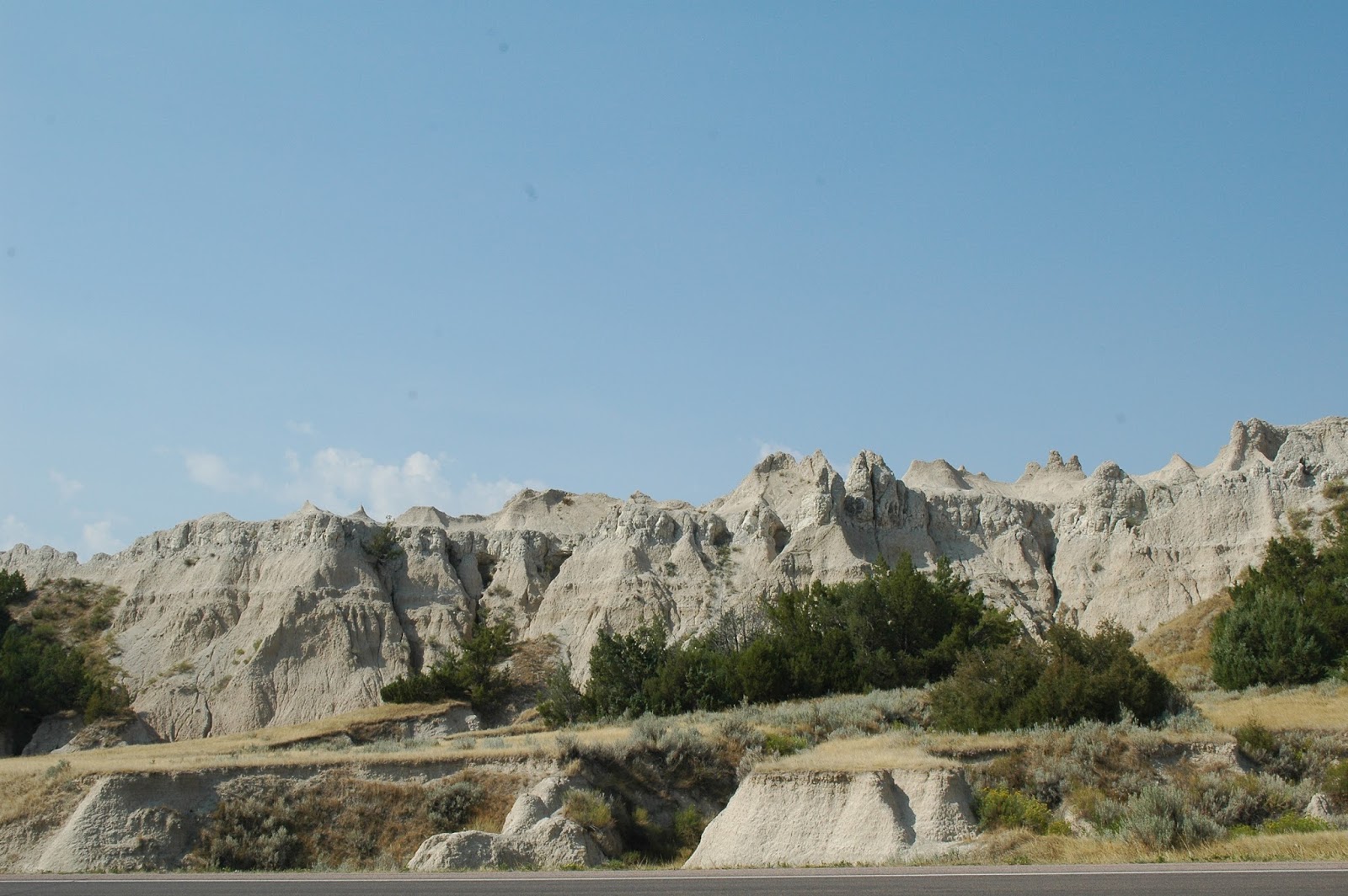
How did the Badlands form? Layers of sediments were deposited over a period of about 40 million years, beginning 67 to 75 million years ago. The oldest (and bottom) layer is muddy sea floor, complete with ocean fossils. Other layers were deposited by flooding rivers (when the area was a tropical forest), or most recently, ash from volcanic eruptions. These sediments all compressed into sedimentary rock and each layer is its own color. Erosion gives us the shape of the formations. Modern rivers scoured away at the layers of sediments, creating the peaks and canyons that we see today.
Badland formations

Badland formations

Here we can see where a river is
still carving out a canyon


Badland formations


Badland formations
That’s it for this year’s Nature Minute road trip. I hope to more travelling in the future and share more stories from the road. I encourage you to go seek your own adventures in the wild. This week’s information comes from the National Park Service (wildlife and geology). 

Thursday, October 5, 2017

Road Trip Adventure- Wind Cave

As promised, this week we are going inside Wind Cave National Park in South Dakota. This little gem is separated from Custer State Park by just a cattle guard. Eastern tallgrass and western shortgrass prairies mingle with Rocky Mountain and boreal forests here, all on top of the largest cave system in the US. Enjoy another story from the road.
I was looking forward to visiting Wind Cave NP, even before I learned just how extensive the cave system is. I was even more excited when I got to the visitor center and saw black-footed ferret on display. Shortly after crossing the cattle guard from Custer State Park, I saw a little weasel run halfway across the road, then turn around and run back. In the visitor center, I immediately recognized the black-footed ferret as the little critter I saw. I was excited because that little guy is one of the rarest mammals in North America. 
Black-footed ferret (NPS photo)
Thought to be extinct, wildlife managers recently began reintroducing the black-footed ferret after a colony was found in Wyoming. They began a captive breeding program and ferrets were reintroduced in several locations in the west, including Wind Cave, but only four colonies are considered self-sustaining. Threats the ferret include habitat loss, loss of prey (prairie dogs), and diseases such as plague and canine distemper.
Moving on to happier topics, I was delighted to learn the National Park Service offered a variety of cave tours. All tours are ranger-led, because with over 100 miles of known passages any many more miles yet to be entered, they don’t want a bunch of people roaming around unattended. I volunteered to enter the cave last and act as our caboose. 
Wind Cave's largest natural entrance
The tour I chose was the “Natural Entrance” tour, because it is shortest and most frequently offered. The cave’s largest natural opening is a very small hole that only a child could fit into. We entered the cave through a door a few feet away from the natural opening. It was put there in the early 20th century when what is today’s national park was then a private homestead. The cave has many different formations, but the most impressive is the rare boxwork formation. Boxwork is thought to form from mineral deposits left behind when water seeps into cracks in the rock, remaining even after the rock erodes or dissolves away. At the end of our tour, I was proud to report that we didn’t lose anyone. 
Boxwork, a rare cave formation

Close-up of some of Wind Cave's intricacies


Inside Wind Cave

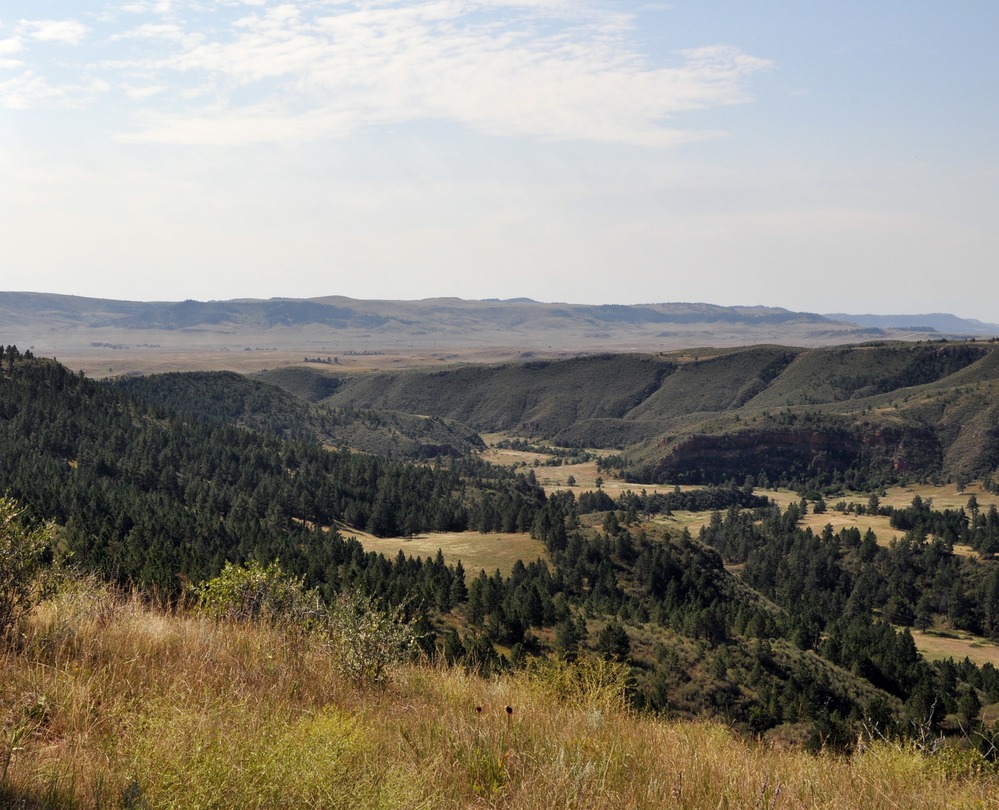
Back above, I enjoyed the panorama of Black Hills, prairie, and pine forest. I even saw a few bison lazing the day away. 
Lazy bison
I also noticed some clouds, and remembered how Wind Cave got its name. In the early 20th century a young boy was roaming the prairie when he heard a rushing noise. He located the cave’s natural opening. The noise he heard was wind rushing out. It blew the hat off his head. He thought it was a cool trick, so he brought his friends the next day. Instead of blowing his hat away, the wind sucked the hat into the cave. The direction of the wind is based on air pressure, and the wind was blowing in when our tour began, a sign of storms in the area. Not long after we left the park, we had a thunderstorm. The cave was true to its word. 
A storm's a-brewin'

Watch this video of a park ranger and Lakota Sioux member telling the story of her people’s emergence from Wind Cave. 
This week's information on black-footed ferrets comes from US Fish and Wildlife Service, the agency overseeing implementation of conservation plans for endangered and threatened terrestrial species. National Park staff frequently request that visitors report sightings of certain animals. Mount Rainier wants us to report mountain lion and bear sightings. Olympic wants us to report fisher sightings. Wind Cave wants us to report black-footed ferret sightings, which I did. The rangers were excited to hear about my sighting because ferrets haven't been seen in the area where I saw mine. Citizen science at its finest!