Translate

Showing posts with label prairie dogs. Show all posts

Thursday, May 21, 2020

Species of the Month

Introduction: This month we take a look at the badger, a tough little critter that's rarely seen.
Living underground and working mostly at night keeps the American badger off the radar for
most of us. More than just Wisconsin's mascot, they can be found all over the west.
American badger (NPS)
Scientific name: Taxidea taxus
Kingdom: Animalia (animals)
Class: Mammalia (mammals)
Order: Carnivora (carnivores)
Notice the large claws on the forefoot (Fort Hayes State University)
Range: Great Lakes region and Central Canada south to Mexico and west to the Pacific
Habitat: Grasslands- fields, meadows, prairies, or pastures
Lifespan: 4-10 years, oldest in the wild was 14
Diet: Fosorial rodents- gophers, moles, ground squirrels, prairie dogs, mice, rats, voles;
snakes; insects; ground nesting birds
Predators: Humans, golden eagles, bobcats, mountain lions, coyotes, bears, wolves
Conservation Status: No special status, but protected from hunting in British Columbia,
Illinois, Michigan, and Wisconsin.
Other Information: The American badger is a member of the weasel family. A flat body,
stubby legs, and long claws for digging make them an ideal underground predator. They
are one of the few predators that will chase their prey underground, either through
existing tunnels or by making their own as they go. Badgers use several burrows in their
territory, so the unused ones often have other animals living in them.
Mother badger with baby (USFWS)

The American badger mates in late summer or early fall, but embryos don't implant in the
uterus until winter. During winter, badgers are typically inactive in a state of torpor, so the
delayed implantation is likely an adaptation to prevent the females from burning through
fat stores while pregnant. Although coyotes are known to prey on badgers, sometimes they
will hunt cooperatively. Coyotes are more successful catching rodents on the surface, and
badgers are more successful catching them in burrows. Working together, they make more
prey available to each other.
Coyote and badger taking a break (USFWS)


This month's information comes from the Animal Diversity Web at University of Michigan.

Friday, November 10, 2017

Feeling a Little Squirrely

If you live near a park, or even just a tree, you’ve probably noticed how busy the squirrels are this time of year. I’ve been watching them scurry about looking for acorns outside my office (no, this isn’t my day job) and getting into fights. In another one of those perfectly timed connections in the natural world, the acorns are dropping with the temperature and giving squirrels a feast to carry them through the lean winter months.

The eastern gray squirrel is the dominant squirrel species in my neck of the woods. Others that I’ve seen in my journeys are the Douglas squirrel and golden mantled ground squirrel in Washington and Oregon, the American red squirrel in South Dakota and Alaska, and I even saw a black squirrel in Minnesota. The black one was actually an eastern gray squirrel with a condition called melanism, which is sort of a reverse albino. 

Douglas squirrel

Golden mantled ground squirrel

Squirrels are one of my favorite critters. They are rodents and belong the family sciuridae. Several species of squirrels have a scientific name beginning with Sciurus and I just love that. Every time I see sciurus it makes me think of scurry, which is what those little guys do when they aren’t climbing trees.

Rodents have front teeth (incisors) that never stop growing. It’s great for beavers, since chomping on trees all night will quickly wear out their teeth. It is also helpful when you’re just a tiny little thing eating nuts and acorns. If you’ve ever gotten close enough to a squirrel to see its teeth, they are frighteningly large considering the size of animal attached to them.
Terrifying squirrel teeth (Capitol Theater)

Squirrels spend a lot of their time in trees, and they are agile climbers but they occasionally have an accident. You didn’t hear it from me, but a squirrel in the park fell into the creek once back in the 90s. It made me promise not to tell, and it’s probably dead by now but it’s best not to take chances. 
Eastern gray squirrel (Ohio Department of Natural Resources)


Red squirrel (World Association of Zoos and Aquariums)
All those nuts and acorns the squirrels are gathering now are too much for a meal and won’t fit inside a squirrel house. So they hide their overstock from other critters that might want them by burying them in the ground. With so many nuts hidden in so many holes, there’s no way a squirrel will remember each hole. The ones that get left behind stand a chance of germinating and growing into trees. So not only are squirrels terribly cute, they are also little horticulturalists.


In addition to your basic tree squirrels, there are also ground squirrels. The ground squirrel side of the family includes marmots, groundhogs, chipmunks, and prairie dogs. While they get their name from their dwelling, ground squirrels are not averse to climbing trees. 
Western chipmunk

Friday, October 13, 2017

Road Trip Adventure- The Badlands

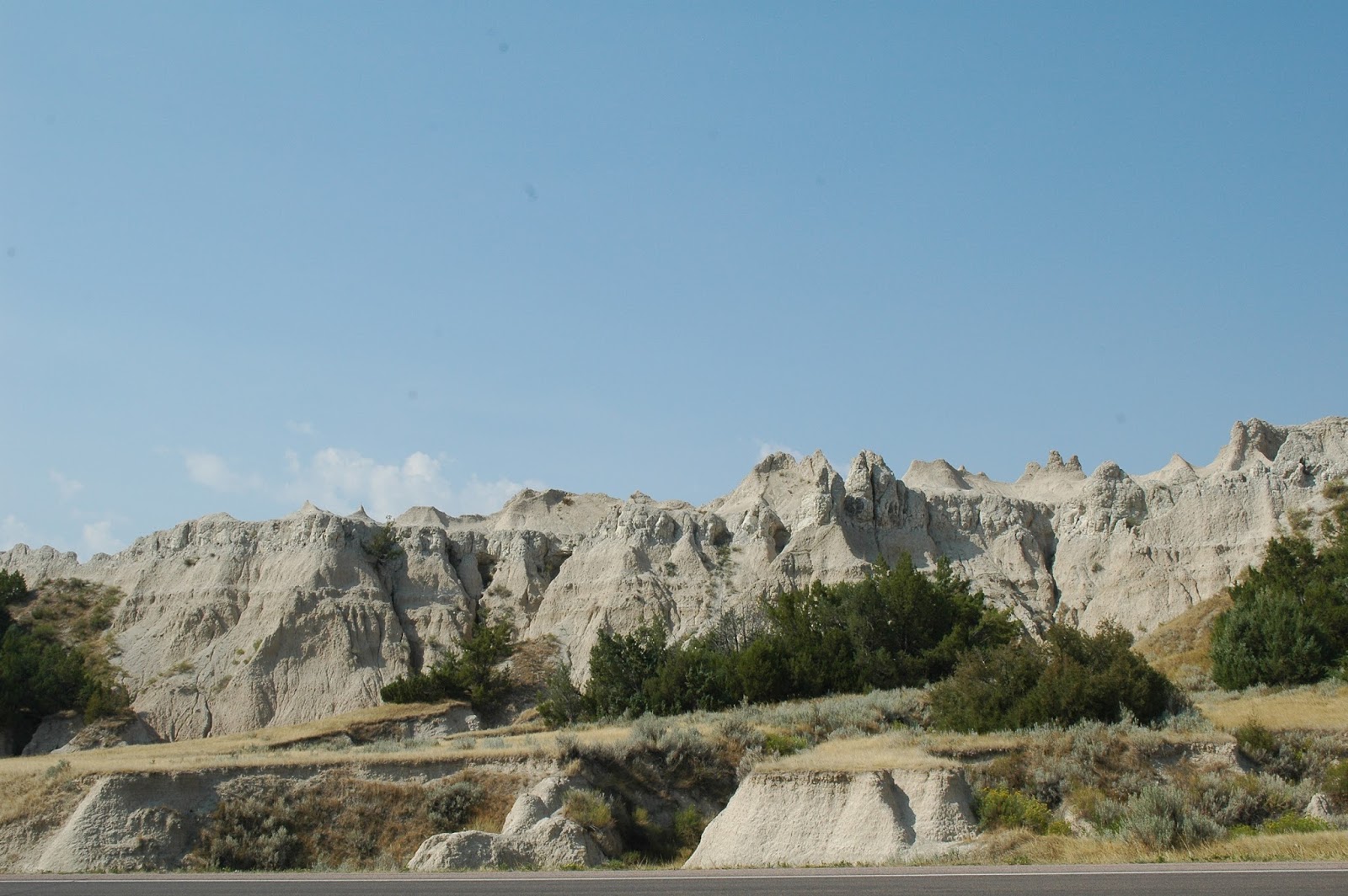
This week’s Nature Minute is the final story from the road. This week we take a look at Badlands National Park in South Dakota. The dazzling colorful rock formations here remind me of the Grand Canyon, though not as grand. I didn’t have time to explore, so I took in as much scenery as I could while cruising through. 
The mixed grass prairie doesn't betray what lies beneath
The first thing I saw when I entered the park was a prairie dog. Despite being known for the rock formations, there is a considerable amount of prairie here, complete with bison, prairie dogs, and reintroduced black-footed ferrets. Shortly after seeing the prairie dogs, I took the first turn (a right, if you’re keeping score) to see just how bad the lands are. There was a bighorn ewe keeping watch over the parking lot, my second critter of the morning. A quick scan of my surroundings revealed a few more sheep picking their way along just beneath the ridgeline.
Bighorn ewe
Like a gaping wound, an opening in the prairie
exposes the colorful bands of sedimentary rock
For being such a bad land, the Badlands hosts an astounding amount of wildlife. According to the National Park Service, 39 species of mammals, 9 reptiles, 6 amphibians, and 206 birds have been documented in the park. In addition to those listed earlier, there are coyotes, bobcats, foxes, two deer species, and pronghorn. Bird species include cliff swallows, horned larks, and northern harriers. Herps include rattlesnakes, snapping turtles, chorus frogs, spadefoot toads, and blotched tiger salamanders.
How did the Badlands form? Layers of sediments were deposited over a period of about 40 million years, beginning 67 to 75 million years ago. The oldest (and bottom) layer is muddy sea floor, complete with ocean fossils. Other layers were deposited by flooding rivers (when the area was a tropical forest), or most recently, ash from volcanic eruptions. These sediments all compressed into sedimentary rock and each layer is its own color. Erosion gives us the shape of the formations. Modern rivers scoured away at the layers of sediments, creating the peaks and canyons that we see today.
Badland formations

Badland formations

Here we can see where a river is
still carving out a canyon


Badland formations


Badland formations
That’s it for this year’s Nature Minute road trip. I hope to more travelling in the future and share more stories from the road. I encourage you to go seek your own adventures in the wild. This week’s information comes from the National Park Service (wildlife and geology). 

Thursday, October 5, 2017

Road Trip Adventure- Wind Cave

As promised, this week we are going inside Wind Cave National Park in South Dakota. This little gem is separated from Custer State Park by just a cattle guard. Eastern tallgrass and western shortgrass prairies mingle with Rocky Mountain and boreal forests here, all on top of the largest cave system in the US. Enjoy another story from the road.
I was looking forward to visiting Wind Cave NP, even before I learned just how extensive the cave system is. I was even more excited when I got to the visitor center and saw black-footed ferret on display. Shortly after crossing the cattle guard from Custer State Park, I saw a little weasel run halfway across the road, then turn around and run back. In the visitor center, I immediately recognized the black-footed ferret as the little critter I saw. I was excited because that little guy is one of the rarest mammals in North America. 
Black-footed ferret (NPS photo)
Thought to be extinct, wildlife managers recently began reintroducing the black-footed ferret after a colony was found in Wyoming. They began a captive breeding program and ferrets were reintroduced in several locations in the west, including Wind Cave, but only four colonies are considered self-sustaining. Threats the ferret include habitat loss, loss of prey (prairie dogs), and diseases such as plague and canine distemper.
Moving on to happier topics, I was delighted to learn the National Park Service offered a variety of cave tours. All tours are ranger-led, because with over 100 miles of known passages any many more miles yet to be entered, they don’t want a bunch of people roaming around unattended. I volunteered to enter the cave last and act as our caboose. 
Wind Cave's largest natural entrance
The tour I chose was the “Natural Entrance” tour, because it is shortest and most frequently offered. The cave’s largest natural opening is a very small hole that only a child could fit into. We entered the cave through a door a few feet away from the natural opening. It was put there in the early 20th century when what is today’s national park was then a private homestead. The cave has many different formations, but the most impressive is the rare boxwork formation. Boxwork is thought to form from mineral deposits left behind when water seeps into cracks in the rock, remaining even after the rock erodes or dissolves away. At the end of our tour, I was proud to report that we didn’t lose anyone. 
Boxwork, a rare cave formation

Close-up of some of Wind Cave's intricacies


Inside Wind Cave

Back above, I enjoyed the panorama of Black Hills, prairie, and pine forest. I even saw a few bison lazing the day away. 
Lazy bison
I also noticed some clouds, and remembered how Wind Cave got its name. In the early 20th century a young boy was roaming the prairie when he heard a rushing noise. He located the cave’s natural opening. The noise he heard was wind rushing out. It blew the hat off his head. He thought it was a cool trick, so he brought his friends the next day. Instead of blowing his hat away, the wind sucked the hat into the cave. The direction of the wind is based on air pressure, and the wind was blowing in when our tour began, a sign of storms in the area. Not long after we left the park, we had a thunderstorm. The cave was true to its word. 
A storm's a-brewin'

Watch this video of a park ranger and Lakota Sioux member telling the story of her people’s emergence from Wind Cave. 
This week's information on black-footed ferrets comes from US Fish and Wildlife Service, the agency overseeing implementation of conservation plans for endangered and threatened terrestrial species. National Park staff frequently request that visitors report sightings of certain animals. Mount Rainier wants us to report mountain lion and bear sightings. Olympic wants us to report fisher sightings. Wind Cave wants us to report black-footed ferret sightings, which I did. The rangers were excited to hear about my sighting because ferrets haven't been seen in the area where I saw mine. Citizen science at its finest!

Saturday, September 30, 2017

Road Trip Adventure- Black Hills

One of my favorite areas in the US is the Black Hills of South Dakota. I first visited the area in 1990 en route to Alaska. Passing through, we stopped at Mount Rushmore. I always wanted to return, and I did in 2007 when moving from Pennsylvania to Washington. However, we were short on time and money so all we got to do was cruise through with another stop at Mount Rushmore. While living in Washington, I always hoped for a vacation that would give me at least a week in the Black Hills. This summer, as part of the Nature Minute road trip, I was able to return for a few days. Enjoy another story from the road.
What makes the Black Hills, or Paha Sapa as the Sioux call it, such a special place? To the Sioux, Paha Sapa is sacred as the heart of the world, and from space it actually looks like a human heart (from Native Americans Online). To me, it’s just this wonderful mix of pine trees and granite rising above the Great Plains. I felt like I was on top of the world. It’s also melting pot of sorts, as the northern and eastern forests converge with the Great Plains and Rocky Mountains.
Black Hills from space (from Four Winds 10)
The Black Hills were originally part of the Sioux reservation until gold was discovered there. The land was stolen and Custer was involved, but that’s another story for another blog. We’re here to focus on nature, and there are a few natural areas protected within the Black Hills. I didn’t get to spend my week there and I didn’t hike at all, but the three areas I got to see from the car were Black Hills National Forest, Wind Cave National Park, and Custer State Park.
The Needles, granite spires in the Black Hills
Black Hills NF is the largest of the three, covering most of the Black Hills. It’s a working, mixed use forest, meaning it is shared by loggers, wildlife, campers, and other recreational users. Ponderosa pine, spruce, birch, and aspen are common trees. Wildlife includes elk, mule and white-tailed deer, coyotes, mountain lions, mountain goats, and bighorn sheep. Birds of prey such as bald eagles and many songbirds are also present.
White-tailed deer right outside our campground

Coyote

Mountain lion

Wind Cave NP is on the fringes of the Black Hills. Eastern tallgrass prairie mixes with western shortgrass prairie topside, while the largest cave in America sits largely unexplored beneath the surface. Mammals there include bison, prairie dogs, black-footed ferrets. More on this location will follow in another Nature Minute.


Prairie dogs

Custer State Park hosts bison and pronghorn herds, along with majestic vistas of rolling hills, vast prairies, and interesting rock formations. It also sits on the fringes, just north of Wind Cave NP.
Bison herd

Pronghorn

Black Hills scenery

Black Hills scenery

How did the Black Hills magically rise above the rest of the prairie? The mountains formed as a result of volcanic activity and uplift in the Tertian period. The central portion is made of granite, pegamite, and sedimentary rock, ringed by increasingly younger layers of sedimentary rock. In most cases, when viewing layers of rock, the older layers are on the bottom. However, there are some areas in the Black Hills where due to uplifting and folding, the older layers are actually on top.
The Black Hills have something to offer, no matter what your interests. History, wildlife, scenery, culture, geology- this place has it all! If you are ever trying to decide where to go for vacation, consider South Dakota.
This week's information comes from Native Americans Online, Black Hills National Forest, and Carleton College.