Translate

Showing posts with label bears. Show all posts

Thursday, September 17, 2020

Species of the Month

The elk rut is upon us, so to that end the Species of the Month for September is the elk. In North America there are four surviving subspecies and two that are extinct. In Eurasia, where it is known as red deer, there are eight subspecies. 
Female elk herd

Scientific name: Cervus elaphus
Kingdom: Animalia (animals) 
Class: Mammalia (mammals) 
Order: Artiodactyla (even-toed ungulates)
Bull elk

Range: Western North America, northern Europe, northern Asia, isolated reintroduced populations in eastern US, introduced populations in Ireland, Argentina, Australia, New Zealand, and Chile
Habitat: Open woodlands
Lifespan: Average 20 years, but difficult to gauge due to hunting
Diet: Grasses, sedges, forbs; woody growth in winter
Predators: Gray wolves, coyotes, mountain lions, bears
Conservation Status: No special protection 
Elk calf nursing

Other Information: The elk is known for the haunting bugle call of the male during the rut. Bugling is used for attracting a mate and advertising territory. Like other horned or antlered mammals, male elk will spar to establish dominance. Dominant males form a harem of females. On occasion, a lesser male will sneak in to mate with one or more of the harem. Elk are social and form segregated herds. Females and calves are dominated by a single alpha female. Males form a bachelor herd. The sexes mingle during the late summer/early fall migration and mating season. Following the birth of calves, mothers and their babies form a separate nursery herd away from the rest of their normal herd. Aside from being larger than deer, elk can also be distinguished by a larger head, dark mane, and large white rump patch. Like deer, elk are most active in early morning and late evening. Coming around a bend on the way to work and seeing the big white butt in the road is a great way to start the day, if given enough stopping distance. Elk browse on grasses and forbs in spring, summer, and fall. Their winter diet may include green woody growth. As ungulates, they have a multi-chambered stomach and chew their cud. Only male elk grow antlers, which they shed annually. Eastern populations of elk were extirpated in the 19th century. Several successful reintroductions of Rocky Mountain elk have since occurred, notably in Elk County, Pennsylvania, and Kentucky.
Bull elk showing off his rump patch

This week's information comes from University of Michigan's Animal Diversity Web. Stay tuned for a recap of the 2020 firefly season next week.

Friday, July 17, 2020

Species of the Month

Introduction: Summer is road trip season, and many people do a road trip through any of
the western national parks. Most folks have a goal of seeing some wildlife, and one of the
iconic animals of the west is the bighorn sheep. They can be seen picking their way along
sheer cliffs in an amazing feat of agility, but I think more people are impressed by rams
crashing into each other head first as they battle for mating rights.
Scientific name: Ovis canadensis
Kingdom: Animalia (animals)
Bighorn ewe enjoying the view

Class: Mammalia (mammals)
Order: Artiodactyla (even-toed ungulates)
Range: Southern Canada south to Mexico, as far east as Texas
Habitat: Mountain meadows, rocky cliffs, deserts
Bighorn rams
Lifespan: 6-15 years, depending on population status
Diet: Grasses, sedges, forbs
Predators: Mountain lions, wolves, coyotes, bears, lynx
Conservation Status: California bighorn sheep subspecies is listed as endangered.
Bighorn lamb taking a break from frolicking
Other Information: There are three subspecies of bighorn sheep: Rocky Mountain, the most numerous
and widespread; California, which is endangered and can be found in the Sierras; and desert bighorn,
which live in the deserts of the US Southwest and Mexico.
Bighorns use rocky slopes and cliffs to avoid and evade predators. Specially built toes allow them to
navigate along ledges that are only inches wide, and excellent depth perception allows them to
accurately leap from one to another.
Bighorns have a shorter lifespan in dynamic populations with a high birth rate, on average 6 or 7 years.
Those in a more stable population with a lower birth rate tend to live longer, to longer than 10 years.
Ewes lounging at the top of a slope
Bighorns live in segregated herds, males in a smaller herd, while females and lambs (male and female)
form larger herds. The herds mingle during the rut, which takes place in fall and early winter. Lambing
occurs in spring, and newborns are able to keep pace with mom almost immediately.
Sparring for mating rights involves males ramming head first into each other at speeds of up to 20
miles per hour. Horns can weigh up to 30 pounds. The force generated is enough to kill a human. Ram
skulls are made of several plates, like human skulls, but the rams' do not fuse into a single solid piece
of bone. That design lets the plates shift to absorb the shock of the repeated blows. The curl of the
horns might also deflect some of the shock away from the head, while a large tendon connecting the
head and neck helps the head recoil.
Rams battling for a mate (Smithsonian)
This week's information comes from University of Michigan's Animal Diversity Web and
Indiana Public Media. Next week wraps up the energy series with a look at the elephant in the room,
nuclear.

Thursday, January 23, 2020

Species of the Month

This month we are looking at one of the largest mammals in North America, the moose. Since they are
found in the northern areas, I decided the dead of winter is a great time to profile this great beast. If you
are ever lucky enough to see one, they are best viewed from a distance. Size may be deceiving. They
move quickly and won't hesitate to mess you up!
Moose in Alaska (NPS)
Scientific name: Alces alces
Kingdom: Animalia (animals)
Class: Mammalia (mammals)
Order: Artiodactyla (even-toed mammals)
Range: Northern North America
Habitat: Forested areas near freshwater
Lifespan: 8-12 years on average
Moose shedding his antler velvet (NPS)
Diet: Twigs, bark, and roots of trees- especially aspen, willow, and conifers; aquatic plants during
summer months
Predators: Wolves, bears (black and grizzly), humans
Conservation Status: Species of Special Concern in Michigan; no special protection in other areas
Other Information: The moose is so cool! Or at least it strives to be. Body size, coupled with an
inability to sweat, means they have to seek shade and water in or to avoid overheating during summer
months. Just how big is a moose? They can grow to be 7 feet tall at the shoulder! Males grow antlers
for mating season and shed them afterwards. Those antlers, largest in the animal world, can span 6 feet.
Calf mortality is high- 50%. Due to their size, calves are more likely than adults to suffer predation by
wolves or bears. Adults are armed with sharp hooves, in addition to those huge antlers on males. Moose
disease is a fatal brainworm parasitic infection, also seen in deer. Ticks also present a problem. They
can weaken a moose to the point of death from blood loss.
Mama moose with calf in Michigan (NPS)

Our moose information comes from University of Michigan's Animal Diversity Web.

Thursday, January 16, 2020

Nature Minute Book Club

Winter is my least favorite time to be outside. It's cold, dark, and precipitating. In fact, I'm expecting snow the day after tomorrow. It's a great time to grab a cup of tea and a good book. Here are some more suggestions for your reading pleasure.

Dolphin Diaries by Dr. Denise L. Herzing
Herzing spent a quarter century in the Bahamas, essentially living among the spotted dolphins, if only
during the summer. During her seasons there she was able to gain unprecedented access to their
behaviors, communications, and rituals. She was seemingly accepted into their society. This book
chronicles the amazing discoveries she made in her time with these fascinating creatures and will
challenge what you think about animal intelligence.
A Sting in the Tale by Dave Ghoulson
Learn about British bumblebees. Ghoulson recounts the history of bumblebees from their appearance
in natural history when dinosaurs roamed the Earth to their problems today. All this, of course, is
interspersed with his own humorous tales from a childhood fascinated with wildlife to his more recent
time in the field tracking down some elusive bees. Oh, and there’s pie.
The Invention of Nature, Alexander Von Humboldt's New World by Andrea Wulf
This biography of Humboldt explores his development from a dutiful son to the father of ecology, even
if the word didn’t yet exist. A contemporary of Darwin’s father, it was he who planted the seeds that
germinated into the theory of evolution. He even warned of human activities influencing the climate,
making him possibly the world's first environmentalist. We discover his intellectual, philosophical, and
artistic influences as well as tag along on his adventures around the world. 
Winter World by Berndt Heinrich
Heinrich is an entomologist by trade, but his keen eye for observation makes him a great naturalist as
well. Part science, part personal narrative and drawing on his own research and observations, in this
book he takes us for a walk through Maine woods to see how critters from flies to bears survive the
brutal Down East winters.

Thursday, October 3, 2019

Be Bear Aware

With the arrival of fall and the approach of winter, food sources are becoming scarce for some animals. Bears spend the winter either hibernating or in torpor, a state of lowered metabolic and other bodily activities. To prepare, they begin gorging themselves this time of year so they can have enough calories to last through an extended period of not eating. While they generally try to avoid humans, now and when they emerge in spring (very hungry) are the most likely times you will encounter a bear. Here are some helpful tips on how to avoid or survive a bear encounter.
Don't let this happen to you! (US Forest Service)
Hungry bears are attracted to food and will follow their noses. When camping, store food, drinks, utensils, cookware, dishes, cosmetics, and hygiene products in a bearproof container, locked in a vehicle, or suspended 10-15 feet above ground and 4 feet on all sides from a climbable surface. Sleep in a tent or camper away from your cooking area. Don't sleep in clothes you cooked in. Don't set up camp near berry patches, carcasses, and bear signs. Avoid foods with a strong smell like bacon and fish, no matter how good they are. Sleep near your flashlight and bear spray. If you see a bear try scaring it away by making loud noises. If it is undeterred, move away to a safe area.
Ideal camp setup (WildAware Utah)
When hiking, if you see a bear that hasn't noticed you, move away quickly, quietly, and calmly. Never try to run from a bear. Running might trigger the chase instinct and the bear will always beat you in a race. If you see a bear and it notices you, let it know that you are human and  not food or another bear. Talk to it calmly, move your arms about, and keep an eye on it without making eye contact. Hopefully the bear will leave. If it does, walk away in a different direction. If it remains, back away slowly but keep making small talk. If the bear approaches you and is acting defensively- making loud noises moving its head around, or stomping or pawing at the ground, stand your ground. If the bear approaches, it's probably bluffing. Keep talking calmly to it, and start backing away when it stops coming at you. If it comes at you again, stop moving but keep talking until it stops again. If it attacks you, now is the time to play dead. Face down on the ground, keep your backpack on if you have one. If the bear rolls you over, keep rolling until you are face down again. Otherwise, don't move and don't make any sound until you're sure the bear is gone.
If you are faced with a quiet bear that won't leave, you'll probably have to fight the bear or at least make it think you want to. If backing away doesn't keep the bear from you and it is behaving calmly, act aggressively to let the bear know that you are not an easy meal. Yell at the bear, make yourself appear as large as possible, throw things at it, swing a large stick at it, and make eye contact. The idea is to make the bear think that since you are crazy enough to fight a bear, it probably shouldn't be messing with you. If the bear decides to attack anyway, fight back with a focus on its face. If you have bear spray, use in situations where the bear is aggressively approaching you. Make sure you are not spraying into the wind, and don't spray it on yourself as a repellent. Read the instructions.
The reason I chose bear safety this week is because I just had my first bear encounter while camping in Virginia. I was tent camping about 30 miles south of Washington, DC and while I got up to use the bathroom at 1 AM a bear took advantage of my absence and ransacked my campsite. It put some holes in my tent, knocked my cooler off the picnic table, and tipped over my folding chair. What did I do wrong? I had my alarm set for 5:30 AM so I could catch an early train into the city. To move more quickly, I had my next day's clothes and my toiletries in the tent with me. That was my first mistake. My second mistake was leaving the cooler in the open. I had 8 bottles of water and 3 glass bottles of root beer in there. I decided the ice would last longer in the woods than it would in the car when drove into civilization, where it's generally hotter. My third mistake, which wasn't really a mistake but just the circumstances, was not having safety in numbers. Bears don't like people; we have a bad reputation in the animal world. Being off-season in the middle of the week, the campground was pretty much empty. With no people around, maybe the bear felt like the campground was OK to stroll through, and the only tent around was an easy target.
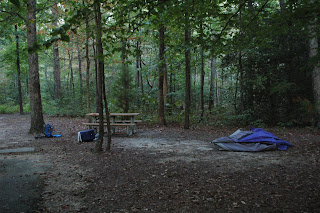
Holes in the tent were on the right side, so I'm guessing
the bear moved right to left, swatting the chair over for
dramatic effect.
When I came back to the campsite, the bear was gone. The tent was a heap, so I spent the rest of the night in the car with the doors locked. Yes, I've seen a news article where a bear gets in a car and steals it.  After sunrise, I inspected the damage. There were holes in the tent, nothing too big but they'll only grow each time the tent is set up. None of the drinks were opened and the glass bottles didn't break. Despite their superhuman strength, bears still need you to open a bottle for them. The chair was fine, but I have no idea why the bear decided to flip it. With a damaged tent, I ended my trip a day early. This week's bear safety tips come from the Grizzly and Wolf Discovery Center right outside fabulous Yellowstone National Park.

Thursday, May 16, 2019

Species of the Month

Wherever you live, fishing season is in full swing. This month we'll profile one of the most common game fishes, the rainbow trout. They can be found in lakes and streams almost everywhere around the world, though introduced to many of them.
Rainbow trout (State Department)
Scientific name: Oncorhynchus mykiss
Kingdom: Animalia (animals)
Class: Actinopterygii (ray-finned fishes)
Order: Salmoniformes 
Range: Pacific coast of North America from Alaska to Mexico
Habitat: Aquatic, some also have a marine phase
Lifespan: 6-8 years average, up to 11 years
Diet: Insects, insect larvae, crustaceans, small fish, algae
Predators: Lampreys, eagles, osprey, herons, mergansers, bears, mink, river otters, seals, sea lions, other fish, humans
Fish on! (NPS)
Conservation Status: No special protection for freshwater only fish; nine populations of steelhead are listed as threatened or endangered
Steelhead (NOAA Fisheries)

Other information: Rainbow trout get their name from a colorful iridescent streak along the sides of its body. State fish and game agencies around the country raise them to stock streams and lakes for fishing season. Stocked trout remain in freshwater; some native trout along the west coast are anadromous (have a saltwater phase) and return to their birthplace to spawn and die. The anadromous trout are called steelhead. Females lay eggs in a gravel nest called a redd. Fertilized eggs hatch after a few weeks, and the hatchling remains attached to the yolk sack as a food source before leaving the redd for the wider world. Young trout tend to stick to slower, shallow water. Young steelhead remain in the stream for up to three years before heading out to sea. Due to habitat degradation and loss, several western steelhead species are listed as threatened or endangered under the Endangered Species Act. Meanwhile, introduced trout are becoming a problem in some areas. They eat and/or outcompete native fishes such as cutthroat and brook trout. They threaten genetic integrity by hybridizing with native species. They also carry a parasite responsible for whirling disease, which causes deformities that make a fish easier prey.
Steelhead (NOAA Fisheries)

This week's information comes from University of Michigan's Animal Diversity Web and the US State Department, of all places.

Thursday, May 9, 2019

Cave Life

This week is Cave Week, so to celebrate we're going spelunking to see what critters we can find. In addition to all sorts of whimsical formations, caves host a surprising amount of life. There are trogolobites, which live full time in caves; trogolophiles, which live in a cave but can also survive outside; and trogoloxenes, the part time cave denizens. You can encounter insects, fish, birds, mammals, plants, fungi, and others. Because there is very little natural light, many of these species are adapted to live in darkness; some don't even have eyes.
Whimsical cave formations

The first cave critter that comes to mind is a bat. Many bats roost in caves because they are cool and dark during the day, making it easier to sleep. Caves make a great place to hibernate over the winter. A constant temperature that is above freezing is an obvious plus, but it's cool enough to trigger the hibernation process. Other cave mammals include bears and jumping mice.
To the bat cave! (National Science Foundation)
Plants are a rare find in  caves because they need sunlight for photosynthesis. I saw ferns growing in a cave under a ceiling hole that opened to the surface. Much more common are fungi, which thrive in dark, damp conditions. Most important among them is Pseudogymnoascus destructans, which causes White Nose Syndrome in bats. It is devastating bat colonies across the US and Canada, and enjoys the cool temperatures while the bats hibernate.
White Nose Syndrome affecting these bats (NPS)
Cave fish are interesting little critters. Nearly all lack eyes and skin pigment. With no light to see by, there is no need to camouflage or stand out, so they are likely to be white or light colored. Unable to see their food, they find it by sensing movement in the water. What exactly do they eat? Since plants, the base of the food chain can't really live in a cave, anything in there either needs to go outside for good or eat whatever gets brought in. Cave fish eat detritus that washes in during rain events. Other critters get by on dung, the leaving of larger animals that way out.
Blind cave fish (NPS, Rick Olsen)
Cave Week runs through this weekend. Find a cave near you and check it out. Spelunk safely. Use the buddy system, carry at least three light sources, and make sure someone knows where you are going. Don't disturb any wildlife and make sure clothing and equipment are thoroughly cleaned before entering another cave. This helps prevent the spread of White Nose Syndrome.
This week's information comes from the National Park Service and National Geographic.


Friday, December 21, 2018

Species of the Month

Up on the rooftop click click click, down through the chimney it's the species of the month! Christmas is right around the corner, so it’s time for another festive species of the month. The caribou is the wild version of the domesticated reindeer. Santa’s herd is safe, but their wild counterparts face habitat loss and in some areas have been hunted to extinction.
Woodland caribou
Scientific name: Rangifer tarandus
Kingdom: Animalia (animals)
Class: Mammalia (mammals)
Order: Artiodactyla (even-toed ungulates)
Range: Circumpolar- Canada, northwestern US, Greenland, northern Europe
Habitat: Arctic tundra and boreal forest
Lifespan: 4.5 years on average
Diet: Leaves, bark, lichen, mushrooms
Predators: Bears and wolves
Conservation Status: Endangered (US), IUCN Species of Least Concern

Lighter colored tundra caribou (NPS)

Other Information: Caribou are the only deer species featuring antlered females. Not all females grow antlers, however. Male antlers are larger and more intricate. Males use theirs in sparring during the rut. Like other deer species, mating is controlled by a dominant bull who fends of younger challengers. The fights leave males injured and/or exhausted and vulnerable to predators. Domesticated reindeer have been used as beasts of burden and for food for thousands of years. There are several subspecies of caribou. Northern caribou are nearly white and smaller than their southern counterparts. In North America, the woodland caribou is a dark brown and critically endangered. Just a handful lived in the wild in Washington and Idaho. Recently, they were all captured and sent to a secure area in British Columbia to protect them from predators in the hopes that their population will increase. Caribou hooves are very large and concave, serving as snowshoes.
Caribou hoof (Where To Next)
The size and shape also aid in swimming. Caribou migrate long distances and must cross many rivers. When walking, they make a loud clicking sound, caused by a foot tendon rubbing on bone.

Information once again comes from the good people at Michigan’s AnimalDiversity Web.

Domestic reindeer (The Nature Conservancy)


Thursday, August 30, 2018

Everglades Flora and Fauna


Last week we explored some of the different habitats in the Everglades. This week we’ll look at some the plant and animal residents, then wrap up with some of the many challenges facing the region.
So many different kinds of animals live in the Everglades. They range from tiny biting flies to giant mosquitoes that can carry you back to their dens and every size of mosquito in between. There are also birds, reptiles, amphibians, mammals, fishes, crustaceans, and arachnids. Many threatened and endangered species call this place home. Some of the highlights: Florida panther, eastern indigo snake, American crocodile, West Indian manatee, five species of sea turtle (leatherback, loggerhead, green, hawksbill, and Atlantic ridley), snail kite, wood stork, piping plover, and red cockaded woodpecker.
Florida panther (US Fish and Wildlife Service)


West Indian manatee

Other critters you can find there include alligators, black bears, deer, marsh rabbits (which is a capable swimmer, gray foxes (which can climb trees), pilot whales, dolphins, several bat species, the gulf toadfish (which is audible to humans), roseate spoonbills, flamingoes, owls, parakeets, shore birds, waterfowl, owls, and birds of prey.
Roseate spoonbill (US Fish and Wildlife Service)

American crocodile (NPS)

Marsh rabbit (North Carolina State Parks)

Plant life in the Everglades includes sawgrass, named for its serrated edges; Simpson’s applecactus, an endangered night-blooming species; wildflowers like climbing aster, coralbean, devil’s potato, and duck potato; several species of orchids that can be found in nearly all of the Everglades habitats, including treetop canopies; and a wide variety of trees. Among the many trees are three mangrove species, West Indies mahogany, live oak, slash pine, bald cypress, gumbo-limbo, buttonwood, royal palm and sabal palm.
Sawgrass (Florida Department of State)

Applecactus (USDA)

Coralbean (NPS)

West Indies mahogany (University of Florida)

Sabal palm (USDA)

Like any other natural area, there is damage caused by humans. Some is recent, but some goes back decades. As development came to Florida, much of the water was diverted by canals. Wetlands were filled in and built over. The diminished flow and water fouled with agricultural runoff and sediment has had far-reaching effects, even today. The current red tide on Florida’s Gulf Coast is likely a result.
Invasive species, especially the Burmese python and boa constrictor, are of increasing concern. These snakes eat just about any native species in the Everglades, including the alligators. With no natural predators, their populations are able to grow unchecked. Although snake hunts are held throughout the year, they are very well camouflaged and are able to escape detection. Another species of concern is the melaleuca tree, which shades out native plants. At least a tree is easier to find than a python. Lionfish are an exotic species that eats the native populations. Increasing demand for them as a food fish is having limited success in eradicating them.
In the marine habitat, propeller scars form when boaters in shallow water mow submerged vegetation or even scrape the sea floor. Scraping bottom is far worse because it kills vegetation directly. It also kicks up sediment, which shades nearby vegetation, indirectly killing more.
The amazing biodiversity of the Everglades leaves quite a lasting impression on visitors. Unfortunately the human impact leaves an even bigger mark on the landscape and wild residential population. While government agencies from the local level up to federal are spending a lot of money to restore the ecosystems, paradoxically, those same governments are allowing more destruction in other parts of the Everglades. It’s a tragic lesson in how our lifestyle choices have consequences most of us never see or think about.
This week's information, like last week, comes from the National Park Service.

Thursday, May 24, 2018

Species of the Month


This month’s species of the month was supposed to be a lichen called lipstick cladonia, but for being a widespread lichen there is very little information about it. So I changed it to something a little easier to research. This past weekend I saw my first eastern bluebird, so that’s what you get this month.
Scientific name: Sialia sialis
Kingdom: Animalia (animals)
Class:   Aves (birds)
Order: Passeriformes (perching birds)
Range: east of the Rockies from southern Canada to Honduras
Habitat: open areas with trees  
Lifespan: 6-10 years, mortality highest in first year
Diet: primarily insects, also seeds, nuts, and berries
Male bluebird with a cricket (Audubon Field Guide)
Predators: Snakes, house cats, raccoons, black bears, American kestrels. Flying squirrels and chipmunks are egg predators. House sparrows and European starling kill bluebirds and/or compete for nesting sites.
Conservation Status: no special protection
Male with brilliant blue on full display (Smithsonian)
Other Information: Bluebirds are a social, yet territorial bird. At times they gather in flocks, but will also defend a nesting territory and feeding territory from other bluebirds. They also have an interesting dynamic with tree swallows. Two pairs of bluebirds will not nest in boxes that are next to each other, and bluebirds will drive away tree swallows if only one box is available. However, placing two boxes side by side will allow the bluebird and the swallow to coexist as neighbors. Male bluebirds have a brilliant blue backside and red breast; females are dull gray with brownish breast. Her eggs are blue, but sometimes white, in clutches of 3-7. Eggs hatch after 13-16 days and the young fledge nest 2-3 weeks after hatching. Pairs may mate twice in a season, and sometimes the young from the first clutch will help raise the second clutch.
Female bluebird looking with muted colors (Cornell Lab of Ornithology)
Information this month comes from the good folks at University of Michigan's Animal Diversity Web again.

Saturday, April 28, 2018

Conservation or Preservation

Conservation and preservation are two tools for environmental protection. They are similar, and many people use the terms interchangeably. The term “conservation” is most frequently used, however. What are the differences, though?
First we’ll look to the federal government for the differences. The US Forest Service practices conservation, while the National Park Service practices preservation. Both agencies protect natural resources, but in different ways and for different reasons.
National Forests were set aside and are managed for conservation. For the most part, they are working forests. The resource (timber) is being conserved- managed logging that ensures there will always be a supply. Certain areas are off-limits to logging for various reasons such as habitat protection or recreation.
National Parks were created “for the benefit and enjoyment of the people”, and in the early days pretty much any enjoyment was acceptable, right up to feeding the bears. As we’ve discovered what damage we’ve caused to the environment, NPS cares less about having all the fun and more about preserving ecosystems and ecological processes. In this sense, preservation- protecting and maintaining the environment- is what many people see as conservation.
The environmental toolbox also includes restoration and enhancement. Restoration is returning a damaged or degraded ecosystem to its former glory. This is a difficult task and rarely achieves perfection because nature is much better at building a system than we are at replicating one. An example of a successful restoration project is at Washington’s Billy Frank Jr Nisqually National Wildlife Refuge. The original coastal wetlands were diked and drained for agriculture. In recent years, the dikes were removed and the tide was allowed to reclaim its former marsh. Salmon took advantage of the new channels that formed. Shorebirds enjoy having a shore again.
Incoming tide at Nisqually's restored tidal wetlands
Enhancement makes improvements to a functional ecosystem. For an example, we’ll return to Washington and visit a tributary of the Nisqually River, the Mashel River. Also a salmon-bearing river, a coalition of public and private agencies put artificial log jams in the river to improve habitat for juvenile salmon. Large woody debris adds nutrients to the river and also creates slower moving, deep pools that give fish a place to rest and hide during flood events. The log jams also reduce erosion by forcing the water to slow down.
Engineered log jam on the Mashel River

You can see an area of calmer water behind the log jam

Even without owning lots of land rich with natural resources, you can still practice conservation and preservation. Conserve water, soil, fuel, and energy. Preserve or enhance the ecology of your property. Resources are available if you need guidance. Ask me for details!