November’s Species of the Month is another animal that
is related to Thanksgiving. Last year, we covered the turkey, which is the
traditional centerpiece in many a holiday feast. But recall that Massasoit’s
braves also arrived at Plymouth with five deer. There are several species of
deer in the world, and even in the US there are more than one. But the species
found in Massachusetts and much of the country is the white-tailed deer.
Scientific name: Odocoileus
virginianus
Kingdom: Animalia (animals)
Class: Mammalia (mammals)
Order: Artiodactyla (even-toed ungulates)
Range: Southern Canada to Bolivia in South America
Habitat: Nearly universal in their range: forest,
grassland, swamp, and urban areas. Wooded cover and open browse are ideal.
Lifespan: 2-3 years in the wild, on average with a
maximum of 20 years.
Diet: Grasses, forbs, shrubs, succulents, twigs and
shoots of trees
Predators: Wolves, coyotes, mountain lions, jaguars,
bears, humans
Conservation Status: No special protection
Other Information: The white-tailed deer is one of
America’s most popular game animals. Hunted nearly to extinction, due to better
game management and habitat enhancement (often incidental to loss of habitat
for other species) it is believed that there are more deer now than in
pre-Columbian times. White-tailed deer are a nuisance in some areas, destroying
crops and ornamental plants, striking vehicles, and overconsuming forest
resources due to overpopulation. They are also disease vectors, hosting ticks
that carry Lyme disease. White-tailed deer also played an important role historically
in the US. Native Americans and European settlers alike used the deer as a
source of food, clothing, and tools. White-tailed deer mate in the fall,
usually in their second year. Births are usually single or double. Fawns can
walk immediately and have no scent. Lack of scent, coupled with camouflage
pattern that makes them resemble the forest floor, is an adaptation to protect
against predators. When startled, the mother will bolt and leave the fawn(s)
behind, triggering a predator’s chase instinct. Bucks grow antlers annually
prior to mating season. They will spar with other males, using antlers as a
weapon and to impress females. Antlers, which are made of bone, grow covered in
velvet, which supplies blood to the growing bone tissue. After the velvet is
shed, the antlers stop growing and eventually weaken and break off after mating
season ends. Summer and winter coats differ in color, ranging from brown to
grayish. The underside of the tail is white and is flicked as a warning signal
to others, giving the white-tailed deer its name. White-tailed deer is an ungulate
and as such, has a multi-chambered stomach like cows. Food is partially broken down,
regurgitated, and digested more completely. This allows the deer to break down
tough cellulose in plant material to more efficiently gain energy from it.
November’s Species of the Month is another animal that
is related to Thanksgiving. Last year, we covered the turkey, which is the
traditional centerpiece in many a holiday feast. But recall that Massasoit’s
braves also arrived at Plymouth with five deer. There are several species of
deer in the world, and even in the US there are more than one. But the species
found in Massachusetts and much of the country is the white-tailed deer.
Scientific name: Odocoileus
virginianus
Kingdom: Animalia (animals)
Class: Mammalia (mammals)
Order: Artiodactyla (even-toed ungulates)
Range: Southern Canada to Bolivia in South America
Habitat: Nearly universal in their range: forest,
grassland, swamp, and urban areas. Wooded cover and open browse are ideal.
Lifespan: 2-3 years in the wild, on average with a
maximum of 20 years.
Diet: Grasses, forbs, shrubs, succulents, twigs and
shoots of trees
Predators: Wolves, coyotes, mountain lions, jaguars,
bears, humans
Conservation Status: No special protection
Other Information: The white-tailed deer is one of
America’s most popular game animals. Hunted nearly to extinction, due to better
game management and habitat enhancement (often incidental to loss of habitat
for other species) it is believed that there are more deer now than in
pre-Columbian times. White-tailed deer are a nuisance in some areas, destroying
crops and ornamental plants, striking vehicles, and overconsuming forest
resources due to overpopulation. They are also disease vectors, hosting ticks
that carry Lyme disease. White-tailed deer also played an important role historically
in the US. Native Americans and European settlers alike used the deer as a
source of food, clothing, and tools. White-tailed deer mate in the fall,
usually in their second year. Births are usually single or double. Fawns can
walk immediately and have no scent. Lack of scent, coupled with camouflage
pattern that makes them resemble the forest floor, is an adaptation to protect
against predators. When startled, the mother will bolt and leave the fawn(s)
behind, triggering a predator’s chase instinct. Bucks grow antlers annually
prior to mating season. They will spar with other males, using antlers as a
weapon and to impress females. Antlers, which are made of bone, grow covered in
velvet, which supplies blood to the growing bone tissue. After the velvet is
shed, the antlers stop growing and eventually weaken and break off after mating
season ends. Summer and winter coats differ in color, ranging from brown to
grayish. The underside of the tail is white and is flicked as a warning signal
to others, giving the white-tailed deer its name. White-tailed deer is an ungulate
and as such, has a multi-chambered stomach like cows. Food is partially broken down,
regurgitated, and digested more completely. This allows the deer to break down
tough cellulose in plant material to more efficiently gain energy from it.November’s Species of the Month is another animal that
is related to Thanksgiving. Last year, we covered the turkey, which is the
traditional centerpiece in many a holiday feast. But recall that Massasoit’s
braves also arrived at Plymouth with five deer. There are several species of
deer in the world, and even in the US there are more than one. But the species
found in Massachusetts and much of the country is the white-tailed deer.
Scientific name: Odocoileus
virginianus
Kingdom: Animalia (animals)
Class: Mammalia (mammals)
Order: Artiodactyla (even-toed ungulates)
Range: Southern Canada to Bolivia in South America
Habitat: Nearly universal in their range: forest,
grassland, swamp, and urban areas. Wooded cover and open browse are ideal.
Lifespan: 2-3 years in the wild, on average with a
maximum of 20 years.
Diet: Grasses, forbs, shrubs, succulents, twigs and
shoots of trees
Predators: Wolves, coyotes, mountain lions, jaguars,
bears, humans
Conservation Status: No special protection
Other Information: The white-tailed deer is one of
America’s most popular game animals. Hunted nearly to extinction, due to better
game management and habitat enhancement (often incidental to loss of habitat
for other species) it is believed that there are more deer now than in
pre-Columbian times. White-tailed deer are a nuisance in some areas, destroying
crops and ornamental plants, striking vehicles, and overconsuming forest
resources due to overpopulation. They are also disease vectors, hosting ticks
that carry Lyme disease. White-tailed deer also played an important role historically
in the US. Native Americans and European settlers alike used the deer as a
source of food, clothing, and tools. White-tailed deer mate in the fall,
usually in their second year. Births are usually single or double. Fawns can
walk immediately and have no scent. Lack of scent, coupled with camouflage
pattern that makes them resemble the forest floor, is an adaptation to protect
against predators. When startled, the mother will bolt and leave the fawn(s)
behind, triggering a predator’s chase instinct. Bucks grow antlers annually
prior to mating season. They will spar with other males, using antlers as a
weapon and to impress females. Antlers, which are made of bone, grow covered in
velvet, which supplies blood to the growing bone tissue. After the velvet is
shed, the antlers stop growing and eventually weaken and break off after mating
season ends. Summer and winter coats differ in color, ranging from brown to
grayish. The underside of the tail is white and is flicked as a warning signal
to others, giving the white-tailed deer its name. White-tailed deer is an ungulate
and as such, has a multi-chambered stomach like cows. Food is partially broken down,
regurgitated, and digested more completely. This allows the deer to break down
tough cellulose in plant material to more efficiently gain energy from it.
November’s Species of the Month is another animal that
is related to Thanksgiving. Last year, we covered the turkey, which is the
traditional centerpiece in many a holiday feast. But recall that Massasoit’s
braves also arrived at Plymouth with five deer. There are several species of
deer in the world, and even in the US there are more than one. But the species
found in Massachusetts and much of the country is the white-tailed deer.
Scientific name: Odocoileus
virginianus
Kingdom: Animalia (animals)
Class: Mammalia (mammals)
Order: Artiodactyla (even-toed ungulates)
Range: Southern Canada to Bolivia in South America
Habitat: Nearly universal in their range: forest,
grassland, swamp, and urban areas. Wooded cover and open browse are ideal.
Lifespan: 2-3 years in the wild, on average with a
maximum of 20 years.
Diet: Grasses, forbs, shrubs, succulents, twigs and
shoots of trees
Predators: Wolves, coyotes, mountain lions, jaguars,
bears, humans
Conservation Status: No special protection
 |
| White-tailed doe resting in the cover of a forest |
Other Information: The white-tailed deer is one of
America’s most popular game animals. Hunted nearly to extinction, due to better
game management and habitat enhancement (often incidental to loss of habitat
for other species) it is believed that there are more deer now than in
pre-Columbian times. White-tailed deer are a nuisance in some areas, destroying
crops and ornamental plants, striking vehicles, and overconsuming forest
resources due to overpopulation. They are also disease vectors, hosting ticks
that carry Lyme disease. White-tailed deer also played an important role historically
in the US. Native Americans and European settlers alike used the deer as a
source of food, clothing, and tools. White-tailed deer mate in the fall,
usually in their second year. Births are usually single or double. Fawns can
walk immediately and have no scent. Lack of scent, coupled with camouflage
pattern that makes them resemble the forest floor, is an adaptation to protect
against predators. When startled, the mother will bolt and leave the fawn(s)
behind, triggering a predator’s chase instinct. Bucks grow antlers annually
prior to mating season. They will spar with other males, using antlers as a
weapon and to impress females. Antlers, which are made of bone, grow covered in
velvet, which supplies blood to the growing bone tissue. After the velvet is
shed, the antlers stop growing and eventually weaken and break off after mating
season ends. Summer and winter coats differ in color, ranging from brown to
grayish. The underside of the tail is white and is flicked as a warning signal
to others, giving the white-tailed deer its name. White-tailed deer is an ungulate
and as such, has a multi-chambered stomach like cows. Food is partially broken down,
regurgitated, and digested more completely. This allows the deer to break down
tough cellulose in plant material to more efficiently gain energy from it.
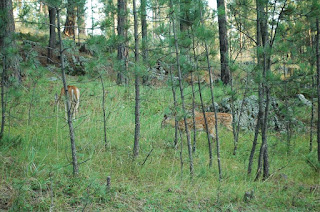 |
A mother and two fawns browse in edge habitat.
A buck is behind and uphill. |


