Translate

Thursday, July 26, 2018

Desert Life


This time of year, there’s usually no place in America that’s hotter than the desert Southwest. The region is known for its striking red sandstone formations, deep canyons, and ancient ruins. While the desert may seem like a barren wasteland to the casual observer, it is full of life. If you know where to look. The critters of the desert have evolved with special adaptations that allow them to survive in a harsh environment. Let’s have a look at some.
Extreme heat and scarce water are two hardships of the desert. Because of the second problem, sweating is an impractical solution to the first problem. As a workaround, the jackrabbit has large ears which are full of blood vessels. The blood vessels bring warmer blood away from the body core to cool. The large surface area of the ears also helps the cooling process (National Geographic).
Black-tailed jack rabbit (NPS)

The kangaroo rat has adapted to life without beverages. It can go an extended period without water, absorbing what it needs from its plant-based diet. Too keep cool, it lives underground and is nocturnal (Arizona-Sonora Desert Museum).
Stephen's kangaroo rat (Arizona-Sonora Desert Museum)
The various cactus species have evolved to avoid water loss. All plants lose water through their leaves in a process called transpiration. Cactus plants minimize the loss by having long, thin needles in place of the leaves we’re familiar with on trees and other leafy plants. They also have an extensive root system for maximizing water collection potential and a wide, hollow stem for water storage (BBC).
Saguaro cactus (US Forest Service)
Other desert plants have adapted as well. Shrubs and non-woody flowers survive by growing deep roots that can reach down into the water table. They have hardy seeds that can last for years before germinating. When the rare shower falls, these plants simultaneously burst to life in a brief but spectacular desert bloom (Science News for Kids).
Superbloom (National Park Service)
The Great Basin spadefoot toad has a cool adaptation for surviving in the desert. They burrow underground and remain in a state of suspended animation for years until rainfall brings it to the surface for mating and feeding. Mating pairs will lay and fertilize eggs anywhere water collects, then the race is on for the eggs to hatch and tadpoles to develop before the water evaporates. The tadpoles are cannibalistic, which might be an incentive to hurry up and grow (The Nature Conservancy).
Great Basin spadefoot toad (Idaho Fish and Game)
You probably don’t think of shrimp living in the desert. The fairy shrimp’s habitat is ephemeral (seasonal) pools that form in depressions in rock. They are tough little buggers, able to withstand extreme heat. Their eggs can survive desiccation for decades, using sugars instead of water inside the egg. The eggs can remain in place until rain activates it and it hatches, or they can be carried on the wind to a new location and hatch there when rain comes (National Park Service).
Fairy shrimp (National Park Service)
Next time you happen to be in the desert, look around for these and other fascinating critters. The desert is alive, if you look hard enough to see the life all around you.

Thursday, July 19, 2018

I Wanna Rock!


Let’s explore a mystery of geology this week. I recently visited a nearby park known for its unusual rocks. Ringing Rocks features a boulder field of musically inclined rocks that ring like bells when struck with a hammer, rather than clunking like a rock.
Approaching the sonorous stones from the woods


The boulder field is surrounded by a hardwood forest. Within the forest are a few scattered boulders. None of the forest boulders were music to my ears, but supposedly the ones in the boulder field that clank are still ringing, just at a pitch too low for humans to detect. Somehow, the interaction with other boulders is what makes the ringing sound.
Boulder field of musical rocks

The rock type is olivine diabase, an iron-rich volcanic material. Being made from iron probably accounts for the metallic sound. The diabase broke into boulders thanks to Pennsylvania’s wonderful cycle of freezing and thawing. Water finds its way into a crack in the rock, expands when it freezes, and over time causes the rock to fracture.  
Me, demonstrating my musical prowess

The boulders in the field are available for you to gleefully tap with you hammer. On the one hand, this is great because anyone and everyone is free to experience the geological oddity. On the other hand, the boulders show noticeable pock marks from years of hammering. Eventually, the boulders will break. Will they lose their ability to carry a tune when that day comes? No one knows for sure.
This week's information comes from Unmuseum and S. S. McCray (Petrogenesis of the Coffman Hill diabase sheet, Easton Pennsylvania (unpublished B.S. thesis)).

Thursday, July 12, 2018

Dead Zones

This week we’re taking a look at a problematic summer tradition: hypoxic dead zones. These are marine or aquatic areas that don’t have enough oxygen to support life. The most famous is probably the dead zone in the Gulf of Mexico. Let’s look at dead zones, how they form, and what you can do to help prevent them.
The most common cause of dead zones is excessive nutrient runoff. Nutrients in this case are nitrogen and phosphorus, nutrients from plants. The main source of this nutrient runoff is agriculture, but it can also come from detergents, animal waste, and untreated sewage.
Gulf of Mexico dead zone (Digital Journal)
The nutrient overload leads to a sudden population boom in the local algae community. It seems paradoxical that algae, which produces oxygen, leads to an area without oxygen. First, when a large mat of algae covers the water’s surface it prevents oxygenation at the water/air interface. Then, when the algae dies and decomposes, that is where the oxygen disappears to. Mobile critters like fish can move to more oxygenated areas to survive, but something that can’t move or is very slow like a starfish or sea urchin will suffocate unless the situation clears up.
How a dead zone forms (Gulf Hypoxia)
Sometimes the algae bloom is of a type that produces toxins. Sometimes the toxins cause fish kills. Shellfish can absorb the toxins through filter feeding and pass them on to predators and people. Algae toxins can even threaten public drinking water.
A closer look at an algae bloom (NOAA)

How can you help? Trying to stop non-point pollution seems hopeless, but if everyone ups their game a little bit it adds up and makes a difference. Simple steps you can take at home include limiting the amount of fertilizer you use for your lawn and garden, cleaning up after your pup, and washing your car in the grass rather than the driveway or street. Reducing fertilizer use reduces the amount of excess nitrogen and phosphorus washing into the storm drain and out to sea. If you’re already doing that, buy organic produce which doesn’t use any fertilizer or pesticide. Picking up your dog poop keeps the nitrogen and phosphorus from that source out of the system as well. Washing your car in the yard lets the phosphorus in the detergent soak into the yard rather than washing into the storm drain. Every little bit helps.
This week's information comes from the EPA.

Friday, July 6, 2018

Species of the Month

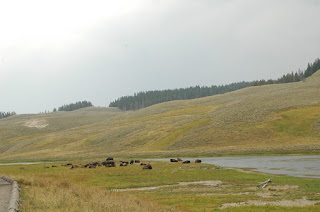
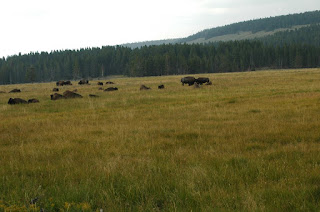
This month’s species of the month celebrates independence with America’s newest national symbol, the bison, which became the national mammal in 2016. For the Plains Indians, the bison meant life. To me, it represents strength, power, and resilience as it was hunted nearly to extinction but has since recovered to an estimated population of 31,000 wild bison. While it’s a far cry from the tens of millions roaming the prairies and woods in the 19th century, it is much better than the thousand or so that remained in 1889. 
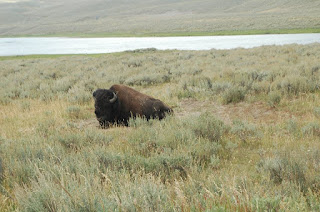
Bull bison at Yellowstone


Scientific name: Bison bison
Kingdom: Animalia (animals)
Class:   Mammalia (mammals)
Order: Cetartiodactyla (even-toed ungulates)
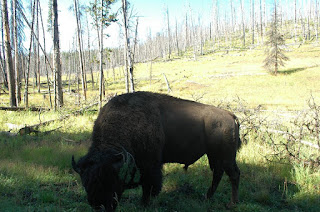
Grazing bison
Range: Historic range runs from Alaska and northern Canada west of Hudson Bay south to northern Mexico, Intermountain West east to the Appalachians. Current range is limited to national parks and preserves, private wildlife conservation areas, and private ranches scattered about the US, Canada, and Mexico.
Habitat: Forest and/or prairie habitat; can be found in tallgrass, shortgrass, or mixed grass prairies
Lifespan: 15-20 years
Diet: grasses, sagebrush
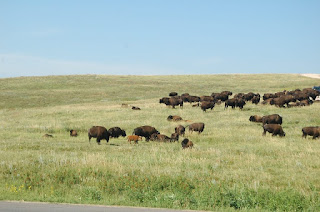
Bison herd at Custer State Park in South Dakota.
The orange colored calf is known as a "red dog".
Predators: wolves, mountain lions, humans
Conservation Status: Listed as near-threatened due to reliance on conservation for survival by IUCN. Listed as endangered under ESA.
Other Information: Bison were long a source of sustenance for the Plains Indians, who used every part of the body for food, clothing, shelter, and tools. They were hunted nearly to extinction in an effort to subdue the tribes that depended on them. Of the roughly 31,000 wild bison, only a small percentage are purebred. The rest are hybridized with domestic cattle. Wild bison herds are scattered throughout the West. Notable herds are found in Yellowstone, Wind Cave, and Wood Buffalo National Parks. There are two subspecies of bison: the familiar plains bison and wood bison, which lives in northern forests of Alaska and Canada. Bison grazing influenced plant communities, which in turn affected what other animals lived in the ecosystem. Bison form segregated herds based on age and sex. Male herds are smaller than female herds, although more males will join as the rut approaches. The rut happens in late summer/early fall. A dominant bull controls a female harem, and younger bulls will challenge him. A bison’s shoulder hump is a mass of muscle that helps support the large head. The giant head works as a snow plow in the winter, clearing snow off the grasses. Despite their docile appearance, bison are capable of inflicting serious damage. They are fast- they can run up to over 30 miles per hour and have no problem using their horns. Keep your distance.
Resting captive bison in Washington


Lamar Valley bison at Yellowstone

Lamar Valley bison at Yellowstone


This week's information comes from University of Michigan's Animal Diversity Web, The Nature Conservancy, US Fish and Wildlife Service, and Environment News Service

Wednesday, June 27, 2018

Thunderbolts and Lightning, Very Very Frightening Me!


Summer is here, the time of lazy days, high heat, fireflies, and of course, thunderstorms. Thunderstorms can happen anywhere at any time, but are most likely to happen when it gets hot. Here in the east where I live, my thunderstorms are most frequently in the late afternoon. In the Midwest, they usually happen in the evening or overnight. Where do these storms come from?

There are two ways for a thunderstorm to form that I’ve noticed. The first is associated with a cold front. Usually, what I’ve seen is we’ll be in a heat wave (three or more days of temperatures above 90̊) and when a cold front comes in to cool things off a bit, the contrast between very hot and less hot air causes enough atmospheric instability that severe thunderstorms form all along the front.
Afternoon thunderstorm building over Pennsylvania
The other situation, and this is my favorite, is what I call the pop-up storm. These happen later in the day and form when the heat and humidity of the day force hot air to rise. As the air rises it cools and condenses into clouds. If the cloud gets tall enough, the water vapor molecules eventually for ice crystals. If the ice crystals collide with each other, they can create an electrical charge. The electrical charge is lightning. A bolt of lightning is hotter than the surface of the sun and causes the air around it to superheat. The rumble of thunder you hear is the sound of superheated air expanding.
Anvil cloud from a dissipating thunderstorm
Lightning is lazy. When cloud-to-ground lightning strikes, it looks for the shortest and easiest path to the ground. That means the tallest object around. Being in a flat, open area (such as a beach, the rim of the Grand Canyon) or on a prominence such as a hill or mountain makes you a target. Avoid those areas. Also, stay away from tall objects like trees. Get out of the water when you hear thunder. A good rule of thumb is if you can hear thunder, the lightning is close enough to hit you. Pretty much anything indoors is a safe place to hide from lightning, as long as it’s not made completely out of metal.
Lightning strikes near Crater Lake
Another way for thunderstorms to kill you is with a flash flood. Don’t try to drive through water on a roadway. Listen for a rushing sound if you’re hiking in a canyon and move to higher ground. Even if it’s not raining where you are, a flood from rain upstream will find you so be aware of local weather conditions.
A pair of storms approaches in Wyoming
Hail sometimes accompanies a thunderstorm. While it can be cool to see everything covered in ice during the summer, large hailstones can cause property, crop, and people damage. An umbrella won’t protect you from a frozen baseball that’s been falling for thousands of feet so get inside. Also, hail is an indicator of possible tornadoes. Refer back to this post from March.
Odds are pretty good you’ll survive the next thunderstorm. Take the time to relax by listening to the sounds of the rain and thunder. Appreciate all the complexities and nuances that go into making nature’s rumbly light show.
This week's information comes via the National Severe Storms Laboratory All photos are my own.